Geology

Definitions and images to illustrate geological terms, links to images and website articles

anatexis

Anatexis (loss of texture) is partial melting of rock under extreme conditions of temperature and pressure.

Anatexis more often results from tectonism (regional metamorphism) than from magmatism (contact metamorphism) because magmas typically carry too little excess heat to melt significant quantities of surrounding rock while themselves continuing to remain molten.

Anatexis provides a common form of magmatic mixing in areas of active magmatism, wherby adjacent magma bodies can develop transient subsurface communications before their eruption or final subsurface emplacement. Anatexis-related magmatic mixing involves the secondary melting of mid- to lower crustal rocks upon contact with much hotter, rising mafic melts of mantle origin, and produces felsic (feldspar- and quartz-rich) magmas in arc and continental rift settings. Such melts may reach high crustal levels carrying both mantle heat and mantle material.

Labels: , , , , ,

| 0 Guide-Glossary

assimilation

Assimilation is that process of magmatic differentiation whereby ascending magmas evolve chemically by recruiting easily melted or dissolved components (fusibles) from the walls of their conduits.

Under the agency of heat and magmatic fluids, ascending magmas pick up volatiles, silica, trace elements, and occassionally fragments of wall rock. The heat that the melt gains by leaving behind quick-freezing refractories (an exothermic process) is typically sufficient to compensate for heat lost in the endothermic reactions required for the assimilation (melting) of country rock components. This trade-off ensures that assimilation can proceed without causing the melt to freeze (solidify).

Any wall rock fragments that survive more or less intact, without completely melting or dissolving into the magma, are called xenoliths. Surviving wall rock crystals are called xenocrysts. Together, xenoliths and xenocrysts provide invaluable information about rarely exposed lower crust and mantle levels by carrying these materials up within the ascending magma.

▪ Bowen's Reaction Series

Labels: , ,

| 0 Guide-Glossary

dike

Dikes or dykes are discordant tabular or sheet-like bodies of magma that cut vertically or almost vertically through and across strata, though some dikes are steeply inclined.

Hundreds of dikes can invade the cone and inner core of a volcano. Dikes may occur in swarms of parallel dikes, particularly where there has been crustal extension. In regions of crustal extension, fracturing may open the route for filling by magma from a deep source, or intrusive magma may promote the fracturing and extension of the crust. Outcrops of dikes can range from a few metres to many kilometres in length, and can spread lateral distances from a few centimetres wide to over 100 m. Very thin dikes or dikelets are sometimes called veins. The Great Dyke of Zimbabwe is a gabbroic mass nearly 500 km long and about 8 km wide [sat. image, 2, 3].

Because dikes intrude relatively cool country rocks, they frequently display a chilled margin, with grain size becoming coarser towards the centre where the rate of cooling has been slower. If the dike cooled very slowly at great depth, the large crystals of pegmatite dikes have had time to form.

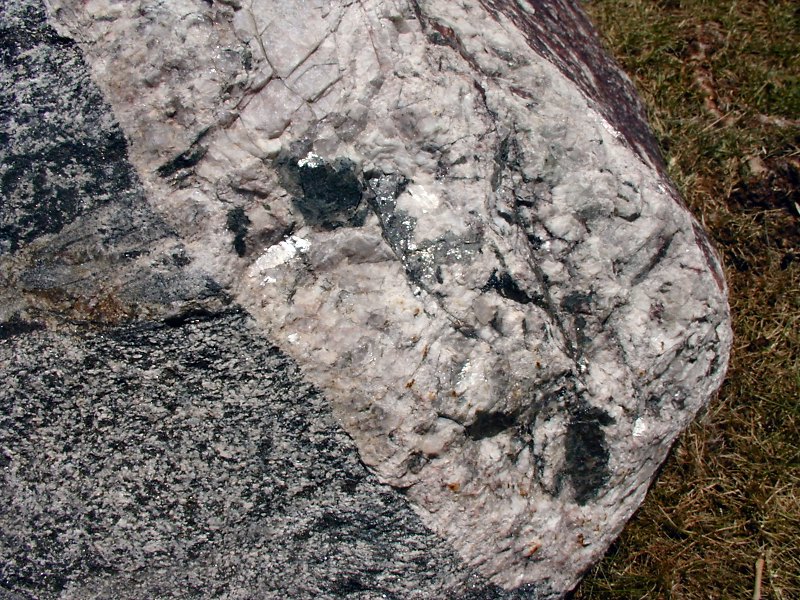
Pegmatite dikes represent crystallization from a residual melt fraction, but pegmatites are formed from a water-rich fluid, so are very coarse grained. Most pegmatites contain quartz, alkali feldspar, micas, and tourmaline. However, some pegmatites contain minerals such as tourmaline, garnets, apatite, beryl, topaz, spodumene, magnetite, sphene (titanite), and zircon, and various other rare minerals. This occurrence of rare minerals results from progressive concentration of trace elements into the last fraction of melt because these elements have not been removed by earlier crystallization during the solidification of the bulk of the magma. [image Pegmatite vein in granite boulder, Glenwood Canyon; Tanco is perhaps the most fractionated igneous body on earth, and a super giant among chemically complex pegmatites]

Aplite dykes are commonly found in granitic bodies. Aplites are light coloured, fine to medium grained, and equigranular. Aplites formed from the ultimate residual melt after most of the crystallization of the granitoid was completed, so aplites are rich in quartz and alkali feldspar and sometimes muscovite. [image links of aplite rock and formations]

Labels: , , , , , , ,

igneous structures

Magma is molten (igneous) rock formed when Earth's radioactivity heats rocks – because of Earth's geothermal gradient, the deeper in the Earth, the greater the temperature.

◙◙ Rock Index: Igneous Rocks ◙◙

Intrusion:
Magma that is emplaced below the surface when molten rock intrudes into or across strata of country rock cools and crystallizes in a variety of intrusive structures, including large plutonic and small hypabassal structures:

intrusive emplacement / structures: ▪ aplite, aplite dike (◙ aplite) ▪ batholith ▪ boudin ▪ bysmalith ▪ concordant ▪ conformable ▪ diapir ▪ diatreme ▪ dike ▪ discordant ▪ enclaves ▪ hypabassal ▪ laccoliths ▪ lopoliths ▪ pluton ▪ sills ▪ strata ▪ volcano ▪ vein ▪

structures reflecting flow/crystallization within magma chambers: ▪ cumulates ▪ enclaves ▪ schlieren ▪ xenoliths ▪

magmatic processes: ▪ anatexis ▪ assimiliation ▪ exchange of volatiles ▪ fractional crystallization ◘ igneous rocks ◘ igneous structures ◘ magma ▪ magmatic differentiation ▪ magmatic mixing ◘ ophiolite complexes ◘ tectonics

Extrusion:
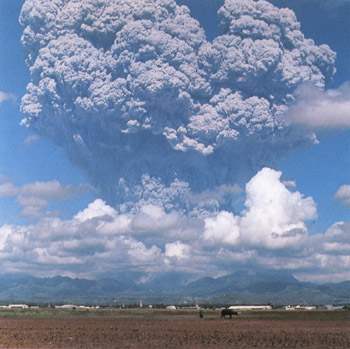
When melted rock flows extrusively or erupts explosively at the surface is called lava – Hawaii's and Iceland's basalt lavas fountain or flow freely, while other lavas are sticky and explosive, producing deadly pyroclastic flows (Mount St. Helens, Vesuvius, Pinatubo).

extrusive: ▪ aphanitic texture ◘ lava ◙ tectonism ◘ volcanoes ▪ vulcanism

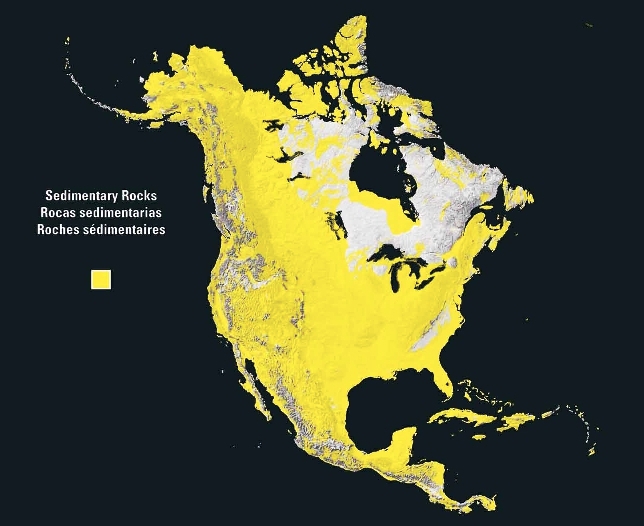
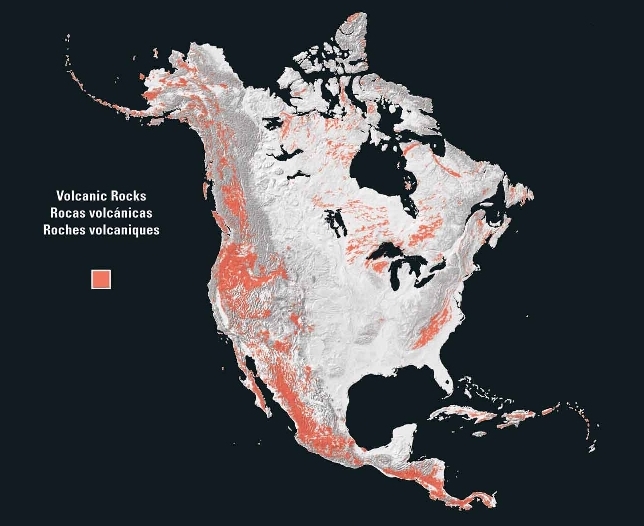
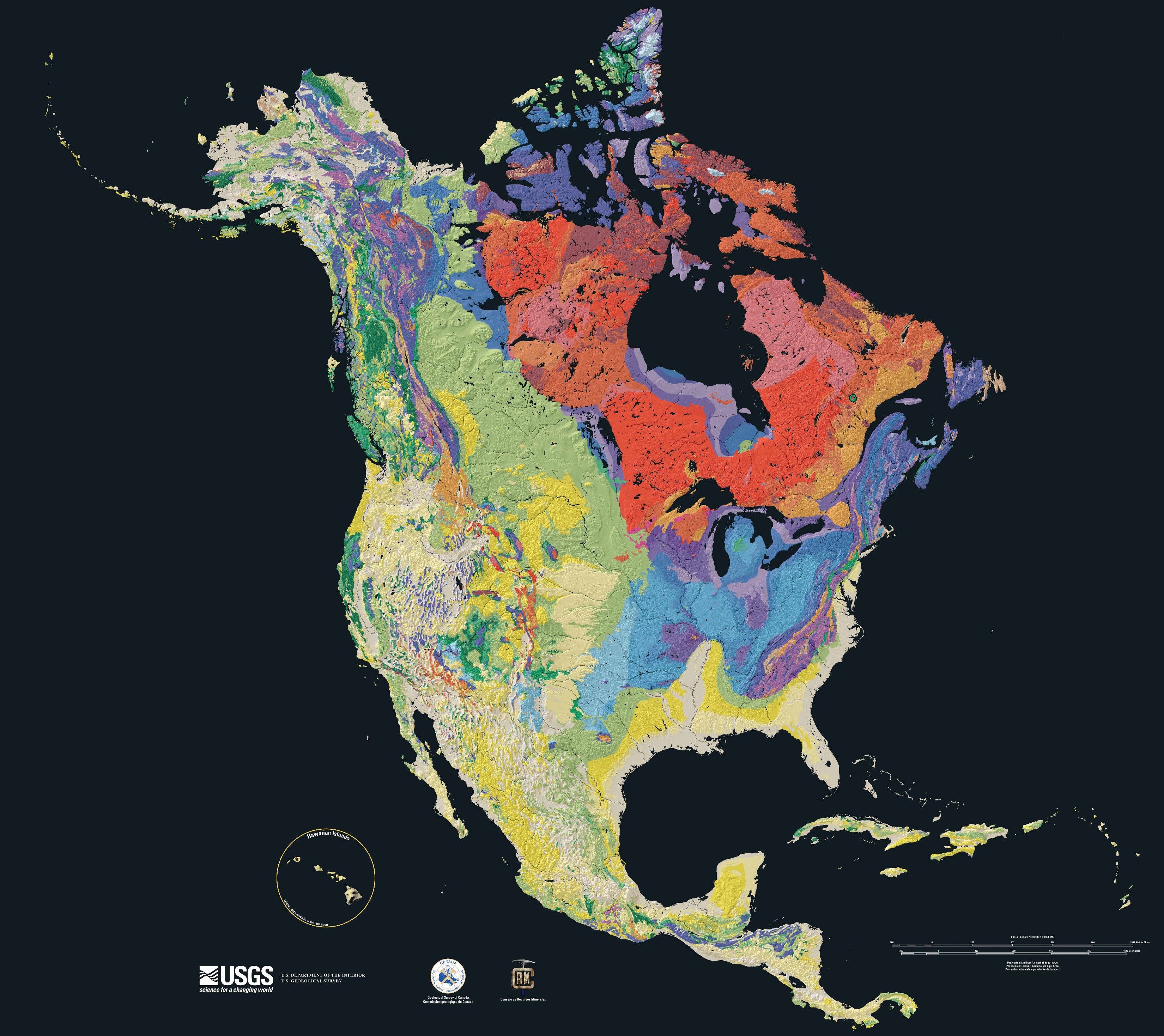
Links: Maps of North American rock types : rock types - metamorphic, plutonic, sedimentary, volcanic; tapestry of time and terrain, terrain.

Labels: , , , , , ,

plutonic

map of plutonic rock of North AmericaPluton is a general term for any large igneous intrusion of crystallized magma. Rocks that emplaced in large intrusive structures are termed "plutonic", whereas those that form in small intrusions are called "hypabyssal".

Plutonic igneous rocks cooled and crystallized from intrusive or irruptive magma within the Earth's crust. Plutonic rocks exhibit a fine-grained aphanitic texture if the magma cooled close to the surface in volcanic necks or feeder pipes, with grain size increasing through to coarse-grained, phaneritic textures for magmas that cooled very slowly at great depth in very large magma chambers. (image - click to enlarge - plutonic rock of North America)

Plutonic rock types include granite, diorite, gabbro, and rhyolite. Plutonic structures include huge solidified magma chambers called batholiths, laccoliths, stocks, bysmaliths, and lopoliths, while smaller hypabyssal structures include diapirs, dikes and dikelets, ring dykes, sills, volcanic necks and plugs, and cone sheets. Less commonly encountered plutonic structures include: phacoliths, cactoliths, ductoliths, harpoliths, sphenoliths, akmoliths, and ethmoliths. Chonoliths are intrusive igneous structure with shapes so irregular that they do not fall into the normal categories. Any intrusive structure may later become exposed at the surface by erosion.

(Veins are finite volumes within rocks, which are filled with crystals of minerals precipitated from hot (aqueous) fluids.)

intrusive emplacement / structures: ▪ batholith ▪ boudin ▪ bysmalith ▪ concordant ▪ conformable ▪ diapir ▪ diatreme ▪ dike ▪ discordant ▪ enclaves ▪ hypabassal ▪ laccoliths ▪ lopoliths ▪ pluton ▪ sills ▪ strata ▪ volcano ▪ vein ▪

structures reflecting flow/crystallization within magma chambers: ▪ cumulates ▪ enclaves ▪ schlieren ▪ xenoliths ▪

magmatic processes: ▪ assimiliation ▪ exchange of volatiles ▪ fractional crystallization ◘ igneous rocks ◘ igneous structures ◘ magma ▪ magmatic differentiation ▪ magmatic mixing ◘ ophiolite complexes ◘ tectonics extrusive: ◘ lava ◘ volcanoes ▪ vulcanism

igneous rocks: ◘ basalt ▪ cumulates ◙ dunites ▪ enclaves ◘ felsic (sial) ◘ gabbro ◘ granite ◙ granodiorite ◊ groundmass ◙ keratophyres ◘ lava ◘ mafic (sima) ◘ magma ◘ ophiolite complexes ◙ pegmatites ◘ peridotite ▪ peridotite ▪ porphyry ▪ schlieren ▪ tonalites ◊ xenocryst ▪ xenoliths

Maps of North American rock types : rock types - metamorphic, plutonic, sedimentary, volcanic; tapestry of time and terrain, terrain.

[images : dike, sill, diapir, laccolith, batholith]

Labels: , , , , , , , , , , , , , ,

texture

The texture of a rock is determined by the size and configuration of its constituent minerals and any presence of gas bubbles. Rock fabric refers to the general appearance of a set of crystals that have grown together to produce a distinctive shape or texture. The term "fabric" is best applied to groups of crystals, or to invidividual crystals within groups, which have grown together so that their growing surfaces have encountered each other. Crystal habit is the general appearance of a crystal that results from the nature and prominence of crystal forms, such as faces or sets of faces. The term "habit" is best applied to invidividual crystals that have grown without their growing surfaces encountering any pre-exisiting solid (encounter = fabric). The microstructure of a rock is its set of structural features, such as grain boundaries, grain size and structure, which can be observed in thin-section (under a microscope).

igneous rocks:
aphanitic – all crystals are too small to be visible to the naked eye or with a hand lens, giving the rock a dull appearance; resulting from rapid cooling in volcanic or hypabyssal (shallow subsurface) environments. Eg. basalt
phaneritic – all crystals sufficiently large to be clearly visible to the naked eye; resulting from slow cooling of magma deep underground in plutonic structures. Eg. granite, gabbro
porphyritic – larger phenocrysts embedded in a finer textured matrix; resulting from two-stage cooling of rising magma, first at depth and subsequently at the surface or shallow subsurface. Eg. porphyry
glassy – non-crystalline rocks; resulting from very rapid cooling of lava at or very near the Earth's surface. Eg. obsidian
vesicular – porous rock with vesicles (holes, pores, or cavities); resulting from gas expansion within rapidly cooling ejected lava. Eg. vesicular basalt
fragmental or pyroclastic – irregular grains welded together, sometimes with glassy shards; resulting from pyroclastic volcanic eruptions. Eg. volcanic tuff, ignimbrites

metamorphic rocks:
foliated – in which mineral constituents are oriented in a parallel or subparallel arrangement resulting from imposed pressure during regional metamorphism. From low to high metamorphic grades:
--slaty – parallel orientation of microscopic grains; Eg. slate
--phyllitic – parallel arrangement of platy minerals, usually micas, that are barely visible to the naked eye; Eg. phyllite
=-schistose – subparallel to parallel orientation of platy minerals such as chlorite or micas; Eg. schists
--gneissic – coarsely foliated texture in which minerals have segregated into discontinuous hands, each of which is dominated by one or two minerals; Eg. gneisses
...granuloblastic – typical of granulites, which have even-sized, granular mineral grains with weak preferred orientation. Microscopic structure reveals small, rounded grains forming a closely-fitted mosaic.
non-foliated – in which constituent minerals lack an ordered arrangement, retaining roughly the orientation of grains present in the country rock before thermal metamorphism; Eg. quartzite, marble, metaconglomerates, hornfels, anthracite coal.

Euhedral crystals are distinct, well-formed crystals with sharp, easily-recognized faces (almandine garnet in quartzitic gneiss at left).

Euhdral is opposite to the interlocked grains of anhedral textured rocks that have cooled in the crowded environment of magma chambers. Subhedral crystals are intermediate in character between distinct euhedral crystals and enmeshed anhedral textures.

Labels: , , , , , , , , , , , , , ,

volcanism

diagram of stratovolcanobasaltic lava flowThe term 'volcanism' refers to volcanoes and volcanic processes.

Magma is molten (igneous) rock formed when Earth's radioactivity heats rocks to high temperatures – the deeper in the Earth, the greater the temperature.

When melted rock flows at the surface it is called lava – Hawaii's and Iceland's basalt lavas fountain (below center) or flow (above right) freely, while other lavas are sticky and explosive, producing deadly pyroclastic flows (nuee ardentes, such as that which killed victims at Pompeii) and towering clouds (below right, below left; pyroclastic flow, Mount St. Helens, 2, Vesuvius, Pinatubo, Soufrière Hills Volcano on Montserrat, Ischia deposits). .

.

..Plinian eruption of Klyuchsvskaya in Russiapyroclastic cloud above erupting andesitic stratovolcanolava fountain and lava flow, Kilauea, Hawaii

[links: images: webpages: Vesuvius victims 'died instantly' ]

Video The Ring of Fire

images : USGS : top right, schematic of stratovolcano; top left, basaltic lava; bottom right, Plinian eruption of Mt. Klyuchsvskaya in Russia; lava fountain and lava flow, Kilauea, Hawaii; pyroclastic cloud above erupting andesitic stratovolcano.

Labels: , , , , , ,

| 0 Guide-Glossary

xenoliths

Xenoliths, meaning 'foreign stones', arise when fragments of metamorphically altered country rock fall into magma or lava and become enveloped within igneous rock. Xenoliths can be engulfed along margins of magma chambers, torn loose from the walls of a conduit for erupting lava or an explosive diatreme, or picked up along the base of flowing lava. Xenoliths can be quite large and xenoliths can occur in clusters within the plutonic rock or demonstrate dikelet intrusions by the magma.

Xenoliths are distinguished from paleosomes, which are older bodies comprising refractory minerals that failed to melt within migmatites (in which more fusible neosomal minerals melted during Barrovian regional metamorphism).

[images : xenolith of peridotite embedded in vesicular basalt?; olivine in peridotite xenolith in alkali basalt; xenolith of partly melted metamorphic rock embedded in solidied lava; xenolith embedded in granite, Garnet Canyon, Tetons, WY; xenolith in pink granite, 2; xenolith in granodiorite, and close-up of boundary; xenolith of biotite-rich schist enclosed in Petersburg Granite; xenolith; xenolith in a basaltic sill; spinel lherzolite xenoliths, San Carlos AZ; xenolith of spinifex-textured basalt within vesicular dacite glass; altered xenolith of spinifex rock in altered and veined dacite; xenoliths in boulder; Shiprock xenolith; formations: xenolith of a quartz-biotite gneiss into which granite was intruded; xenolith in granite quarry, Elberton, GA, 2; excellent, though large bandwidth, illustrations of a xenolith in the Halifax Pluton]

Labels: , , , , , , , , , , , , , , ,

. . . evolving since 01/07/07