Geology

Definitions and images to illustrate geological terms, links to images and website articles

gabbro

close-up of surfaces of various gabbrosGabbro is a coarse-grained, plutonic igneous rock that forms at spreading centers in rift zones and mid-ocean ridges (so underlies oceanic crust). Gabbros can form as massive uniform intrusions or as layered ultramafic intrusions formed by settling of pyroxenes and plagioclase (pyroxene-plagioclase cumulate).

As an essential component of the oceanic crust, gabbros are found in many ophiolite complexes in the sheeted dyke zone to massive gabbro zone (zones III and IV). Long belts of gabbroic intrusions are typical at proto-rift zones and around ancient rift zone margins, where they intrude into the rift flanks.

Gabbro is a dense rock that is greenish or dark-colored and comprises varied percentages of pyroxenes, plagioclase, amphiboles, and olivine. Where olivine is present in large quantities, the rock is termed olivine gabbro.

A finer grained rocks with the same composition as gabbro is termed diabase.

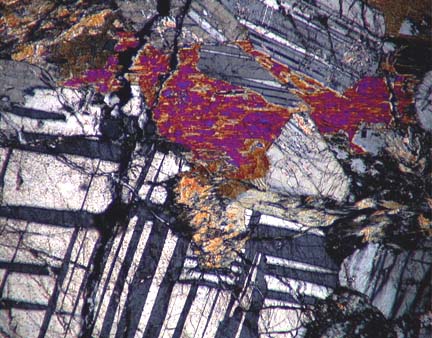
[images : layered gabbro, North Cascades : Salem gabbro-diorite cut by a a composite dike with felsic margins and a central core of basaltic rock : White Mountain Magma Series : pegmatitic gabbro : oceanic crust exposed on Cyprus : oceanic crust gabbro, 2 : thin section Oman Ophiolite gabbro : thin section of olivine gabbro - pyroxene and olivine show bright colours, striped grey rectangular crystals are plagioclase feldspar : thin section of gabbro with plagioclase and hypersthene (orthopyroxene) : hypersthene gabbro : thin section with pyroxene and (striped) plagioclases : thin section orthopyroxenes crystals surrounded by alteration (uralite) : thin section : thin section with twinned plagioclases ]

Labels: , , , ,

peridotite

peridotite xenolith in a typical olivine-rich peridotite cut by a centimeter-thick layer of greenish-black pyroxenite, San Carlos, southwestern United States. Peridotite is an ultramafic, ultrabasic (less than 45% silica), dense, plutonic igneous rock comprising mostly olivine and pyroxene. Most of the Earth's upper mantle (asthenosphere) is composed of peridotite that originated during the accretion and differentiation of the Earth, or that has differentiated, by precipitation of olivine ± pyroxenes, from basaltic or ultramafic magmas in turn derived from partial melting of the upper mantle peridotites. Deeper in the crust, olivine is replaced by a high pressure polymorphs, so peridotites do not occur at depths greater than 400 km.

Peridotite emplaced in the continental crust is typically found in obducted ophiolite complexes, as xenoliths in basalts and kimberlite pipes, and as orogenic peridotite massifs and alpine peridotites. Olivine is unstable at shallow depths and reacts rapidly with water, so that much surface peridotite has been altered to serpentinite by a process in which the pyroxenes and olivines are converted to green serpentine.


Labels: , , , , , , , , , , , ,

xenoliths

Xenoliths, meaning 'foreign stones', arise when fragments of metamorphically altered country rock fall into magma or lava and become enveloped within igneous rock. Xenoliths can be engulfed along margins of magma chambers, torn loose from the walls of a conduit for erupting lava or an explosive diatreme, or picked up along the base of flowing lava. Xenoliths can be quite large and xenoliths can occur in clusters within the plutonic rock or demonstrate dikelet intrusions by the magma.

Xenoliths are distinguished from paleosomes, which are older bodies comprising refractory minerals that failed to melt within migmatites (in which more fusible neosomal minerals melted during Barrovian regional metamorphism).

[images : xenolith of peridotite embedded in vesicular basalt?; olivine in peridotite xenolith in alkali basalt; xenolith of partly melted metamorphic rock embedded in solidied lava; xenolith embedded in granite, Garnet Canyon, Tetons, WY; xenolith in pink granite, 2; xenolith in granodiorite, and close-up of boundary; xenolith of biotite-rich schist enclosed in Petersburg Granite; xenolith; xenolith in a basaltic sill; spinel lherzolite xenoliths, San Carlos AZ; xenolith of spinifex-textured basalt within vesicular dacite glass; altered xenolith of spinifex rock in altered and veined dacite; xenoliths in boulder; Shiprock xenolith; formations: xenolith of a quartz-biotite gneiss into which granite was intruded; xenolith in granite quarry, Elberton, GA, 2; excellent, though large bandwidth, illustrations of a xenolith in the Halifax Pluton]

Labels: , , , , , , , , , , , , , , ,

. . . evolving since 01/07/07