Geology

Definitions and images to illustrate geological terms, links to images and website articles

gabbro

close-up of surfaces of various gabbrosGabbro is a coarse-grained, plutonic igneous rock that forms at spreading centers in rift zones and mid-ocean ridges (so underlies oceanic crust). Gabbros can form as massive uniform intrusions or as layered ultramafic intrusions formed by settling of pyroxenes and plagioclase (pyroxene-plagioclase cumulate).

As an essential component of the oceanic crust, gabbros are found in many ophiolite complexes in the sheeted dyke zone to massive gabbro zone (zones III and IV). Long belts of gabbroic intrusions are typical at proto-rift zones and around ancient rift zone margins, where they intrude into the rift flanks.

Gabbro is a dense rock that is greenish or dark-colored and comprises varied percentages of pyroxenes, plagioclase, amphiboles, and olivine. Where olivine is present in large quantities, the rock is termed olivine gabbro.

A finer grained rocks with the same composition as gabbro is termed diabase.

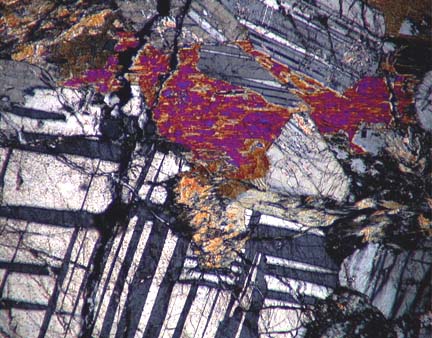
[images : layered gabbro, North Cascades : Salem gabbro-diorite cut by a a composite dike with felsic margins and a central core of basaltic rock : White Mountain Magma Series : pegmatitic gabbro : oceanic crust exposed on Cyprus : oceanic crust gabbro, 2 : thin section Oman Ophiolite gabbro : thin section of olivine gabbro - pyroxene and olivine show bright colours, striped grey rectangular crystals are plagioclase feldspar : thin section of gabbro with plagioclase and hypersthene (orthopyroxene) : hypersthene gabbro : thin section with pyroxene and (striped) plagioclases : thin section orthopyroxenes crystals surrounded by alteration (uralite) : thin section : thin section with twinned plagioclases ]

Labels: , , , ,

ophiolites

Ophiolites (Mohorovičić discontinuity) in Gros Morne National Park, Newfoundland, CanadaOphiolite complexes, or ophiolites (for 'snake stones') are uplifted or emplaced sections of oceanic crust and subjacent upper mantle that have become exposed within rocks of the continental crustal. The age of ophiolite formation is often quite close to the age of their emplacement into the continental crust. (left - click to route to larger image - Ophiolites (Mohorovičić discontinuity) in Gros Morne National Park, Newfoundland.)

Most ophiolites are assigned to either the Tethyan or Cordilleran groups, which have different modes of emplacement yet are both SSZ in origin. The episodic emplacement of ophiolites throughout geological history suggests that the complexes formed and emplaced at times of super-continent break-up and dispersal when large ocean basins adjacent to super-continents subducted as rifting progressed.

Tethyan ophiolites are named for the ancient Tethys ocean, and are found in the eastern Mediterranean areas ( Troodos in Cyprus, Semail in Oman). These are relatively complete classic ophiolite assemblages that were emplaced intact onto a passive continental margin.

Cordilleran ophiolites are named for the Cordillera mountain belts of western North America. These ophiolites are not associated with a passive continental margin and sit on subduction zone accretionary complexes (subduction complexes). Cordilleran ophiolites include the Coast Range ophiolite of California, the Josephine ophiolite of the Klamath Mountains (California, Oregon), and ophiolites in the southern Andes of South America.

Ophiolite assemblages in collisional mountain belts, such as the Alps, represent incipient ocean crust at thinned continental margins (formed during rifting and continental drift) that was emplaced into the collision zone.

The stratigraphic sequences observed in some ophiolites suggest origins in lithosphere-forming, spreading centers at mid-oceanic ridges. Supra-subduction zone (SSZ) ophiolites are more closely related to island arcs than to ocean ridges, and are formed by rapid extension of fore-arc crust during subduction initiation followed by rebound of the continental crust carrying forearc lithosphere (ophiolite) atop it. The occurrence of ophiolite complexes within orogenic belts documents the former existence of ocean basins now consumed by subduction, so providing supporting evidence for plate tectonics.

more information plus image links

Labels: , , , , , ,

peridotite

peridotite xenolith in a typical olivine-rich peridotite cut by a centimeter-thick layer of greenish-black pyroxenite, San Carlos, southwestern United States. Peridotite is an ultramafic, ultrabasic (less than 45% silica), dense, plutonic igneous rock comprising mostly olivine and pyroxene. Most of the Earth's upper mantle (asthenosphere) is composed of peridotite that originated during the accretion and differentiation of the Earth, or that has differentiated, by precipitation of olivine ± pyroxenes, from basaltic or ultramafic magmas in turn derived from partial melting of the upper mantle peridotites. Deeper in the crust, olivine is replaced by a high pressure polymorphs, so peridotites do not occur at depths greater than 400 km.

Peridotite emplaced in the continental crust is typically found in obducted ophiolite complexes, as xenoliths in basalts and kimberlite pipes, and as orogenic peridotite massifs and alpine peridotites. Olivine is unstable at shallow depths and reacts rapidly with water, so that much surface peridotite has been altered to serpentinite by a process in which the pyroxenes and olivines are converted to green serpentine.


Labels: , , , , , , , , , , , ,

. . . evolving since 01/07/07