


dike
Dikes or dykes are discordant tabular or sheet-like bodies of magma that cut vertically or almost vertically through and across strata, though some dikes are steeply inclined.
Hundreds of dikes can invade the cone and inner core of a volcano. Dikes may occur in swarms of parallel dikes, particularly where there has been crustal extension. In regions of crustal extension, fracturing may open the route for filling by magma from a deep source, or intrusive magma may promote the fracturing and extension of the crust. Outcrops of dikes can range from a few metres to many kilometres in length, and can spread lateral distances from a few centimetres wide to over 100 m. Very thin dikes or dikelets are sometimes called veins. The Great Dyke of Zimbabwe is a gabbroic mass nearly 500 km long and about 8 km wide [sat. image, 2, 3].
Because dikes intrude relatively cool country rocks, they frequently display a chilled margin, with grain size becoming coarser towards the centre where the rate of cooling has been slower. If the dike cooled very slowly at great depth, the large crystals of pegmatite dikes have had time to form.
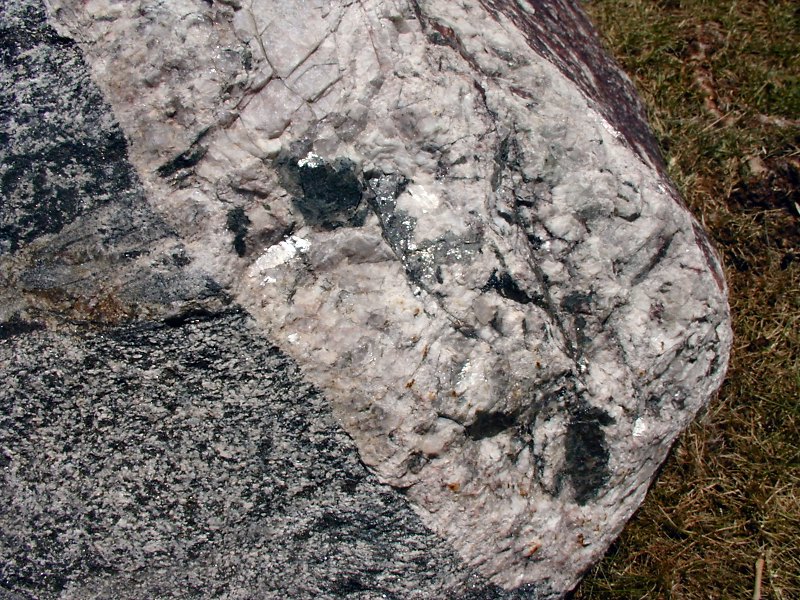
Pegmatite dikes represent crystallization from a residual melt fraction, but pegmatites are formed from a water-rich fluid, so are very coarse grained. Most pegmatites contain quartz, alkali feldspar, micas, and tourmaline. However, some pegmatites contain minerals such as tourmaline, garnets, apatite, beryl, topaz, spodumene, magnetite, sphene (titanite), and zircon, and various other rare minerals. This occurrence of rare minerals results from progressive concentration of trace elements into the last fraction of melt because these elements have not been removed by earlier crystallization during the solidification of the bulk of the magma. [image Pegmatite vein in granite boulder, Glenwood Canyon; Tanco is perhaps the most fractionated igneous body on earth, and a super giant among chemically complex pegmatites]
Aplite dykes are commonly found in granitic bodies. Aplites are light coloured, fine to medium grained, and equigranular. Aplites formed from the ultimate residual melt after most of the crystallization of the granitoid was completed, so aplites are rich in quartz and alkali feldspar and sometimes muscovite. [image links of aplite rock and formations]

Hundreds of dikes can invade the cone and inner core of a volcano. Dikes may occur in swarms of parallel dikes, particularly where there has been crustal extension. In regions of crustal extension, fracturing may open the route for filling by magma from a deep source, or intrusive magma may promote the fracturing and extension of the crust. Outcrops of dikes can range from a few metres to many kilometres in length, and can spread lateral distances from a few centimetres wide to over 100 m. Very thin dikes or dikelets are sometimes called veins. The Great Dyke of Zimbabwe is a gabbroic mass nearly 500 km long and about 8 km wide [sat. image, 2, 3].


Because dikes intrude relatively cool country rocks, they frequently display a chilled margin, with grain size becoming coarser towards the centre where the rate of cooling has been slower. If the dike cooled very slowly at great depth, the large crystals of pegmatite dikes have had time to form.

Pegmatite dikes represent crystallization from a residual melt fraction, but pegmatites are formed from a water-rich fluid, so are very coarse grained. Most pegmatites contain quartz, alkali feldspar, micas, and tourmaline. However, some pegmatites contain minerals such as tourmaline, garnets, apatite, beryl, topaz, spodumene, magnetite, sphene (titanite), and zircon, and various other rare minerals. This occurrence of rare minerals results from progressive concentration of trace elements into the last fraction of melt because these elements have not been removed by earlier crystallization during the solidification of the bulk of the magma. [image Pegmatite vein in granite boulder, Glenwood Canyon; Tanco is perhaps the most fractionated igneous body on earth, and a super giant among chemically complex pegmatites]
Aplite dykes are commonly found in granitic bodies. Aplites are light coloured, fine to medium grained, and equigranular. Aplites formed from the ultimate residual melt after most of the crystallization of the granitoid was completed, so aplites are rich in quartz and alkali feldspar and sometimes muscovite. [image links of aplite rock and formations]
Labels: aplite dike, dike, dikelet, magma, pegmatite, pegmatite dike, strata, volcano