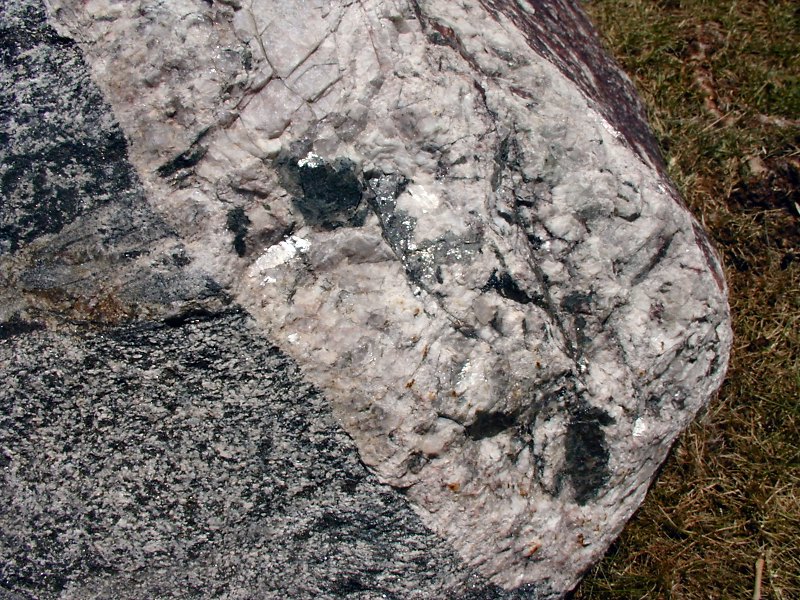
magmatic differentiation
Magmatic differentiation is a complex process whereby a single melt can produce a wide variety of different igneous rocks. Some degree of differentiation typically develops across space and time in exposed magma bodies (intrusive or extrusive).
Most melts develop in the lower crust or in the asthenosphere (upper mantle), so, such melts have a primitive mafic or basaltic composition, whereas melts developing in the upper crust have a higher initial silica content.
Regardless of depth of formation, melts ultimately produce igneous rocks that depend on the composition of the original melt, on the properties of wall rocks encountered during ascent, and on rate/s of cooling. The main processes involved in differentiation are assimiliation, exchange of volatiles, fractional crystallization, and magmatic mixing.
▪ Bowen's Reaction Series
[links: animations: fractional crystallization/magmatic settling]

Most melts develop in the lower crust or in the asthenosphere (upper mantle), so, such melts have a primitive mafic or basaltic composition, whereas melts developing in the upper crust have a higher initial silica content.
Regardless of depth of formation, melts ultimately produce igneous rocks that depend on the composition of the original melt, on the properties of wall rocks encountered during ascent, and on rate/s of cooling. The main processes involved in differentiation are assimiliation, exchange of volatiles, fractional crystallization, and magmatic mixing.
▪ Bowen's Reaction Series
[links: animations: fractional crystallization/magmatic settling]
Labels: assimilation, exchange of volatiles, fractional crystallization, magmatic differentiation, magmatic mixing, melts
| 0 Guide-Glossary