The
texture of a rock is determined by the size and configuration of its constituent minerals and any presence of gas bubbles. Rock
fabric refers to the general appearance of a set of crystals that have grown together to produce a distinctive shape or texture. The term "
fabric" is best applied to groups of crystals, or to invidividual crystals within groups, which have grown together so that their growing surfaces have encountered each other. Crystal
habit is the general appearance of
a crystal that results from the nature and prominence of crystal forms, such as faces or sets of faces. The term "habit" is best applied to invidividual crystals that have grown
without their growing surfaces encountering any pre-exisiting solid (encounter = fabric). The
microstructure of a rock is its set of structural features, such as grain boundaries, grain size and structure, which can be observed in thin-section (under a microscope).
igneous rocks:
aphanitic – all crystals are too small to be visible to the naked eye or with a hand lens, giving the rock a dull appearance; resulting from rapid cooling in
volcanic or hypabyssal (shallow subsurface) environments. Eg.
basaltphaneritic – all crystals sufficiently large to be clearly visible to the naked eye; resulting from slow cooling of
magma deep underground in
plutonic structures. Eg.
granite,
gabbroporphyritic – larger
phenocrysts embedded in a finer textured matrix; resulting from two-stage cooling of rising
magma, first at depth and subsequently at the surface or shallow subsurface. Eg.
porphyryglassy – non-crystalline rocks; resulting from very rapid cooling of
lava at or very near the Earth's surface. Eg. obsidian
vesicular – porous rock with vesicles (holes, pores, or cavities); resulting from gas expansion within rapidly cooling ejected
lava. Eg.
vesicular basaltfragmental or
pyroclastic – irregular grains welded together, sometimes with glassy shards; resulting from pyroclastic
volcanic eruptions. Eg. volcanic tuff, ignimbrites
metamorphic rocks:
foliated – in which mineral constituents are oriented in a parallel or subparallel arrangement resulting from imposed pressure during
regional metamorphism. From low to high
metamorphic grades:
--slaty – parallel orientation of microscopic grains; Eg. slate
--phyllitic – parallel arrangement of platy minerals, usually micas, that are barely visible to the naked eye; Eg. phyllite
=-schistose – subparallel to parallel orientation of platy minerals such as chlorite or micas; Eg.
schists--gneissic – coarsely foliated texture in which minerals have segregated into discontinuous hands, each of which is dominated by one or two minerals; Eg.
gneisses...granuloblastic – typical of
granulites, which have even-sized, granular mineral grains with weak preferred orientation. Microscopic structure reveals small, rounded grains forming a closely-fitted mosaic.
non-foliated – in which constituent minerals lack an ordered arrangement, retaining roughly the orientation of grains present in the country rock before
thermal metamorphism; Eg.
quartzite, marble, metaconglomerates,
hornfels, anthracite coal.
 Euhedral
 crystals are distinct, well-formed crystals with sharp, easily-recognized faces (
almandine garnet in
quartzitic gneiss at left).
Euhdral is opposite to the interlocked grains of
anhedral textured rocks that have cooled in the crowded environment of magma chambers.
Subhedral crystals are intermediate in character between distinct euhedral crystals and enmeshed anhedral textures.
Labels: aphanitic, fragmental, glassy, granuloblastic, ignimbrites, lava, magma, phaneritic, phyllitic, porphyritic, pyroclastic flows, texture, tuff, vesicular, volcanic eruption


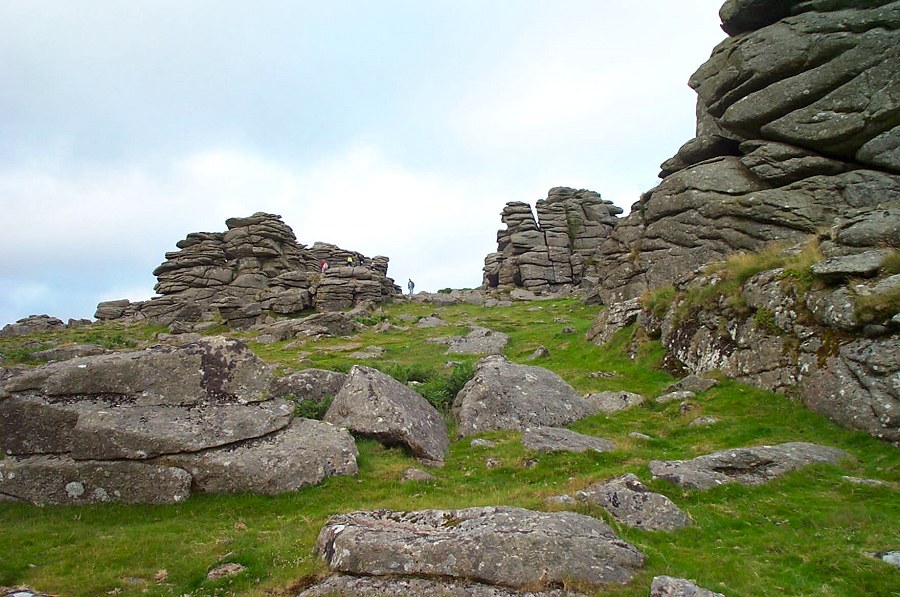
 Granite is typically a medium to coarse grained felsic, intrusive igneous rock (plutonic) that is usually pink to dark gray, sometimes black, depending on its chemistry and mineralogy. Granites are the commonest basement rocks of the continental crust, many dating from the Precambrian.