Geology

Definitions and images to illustrate geological terms, links to images and website articles

Baltica

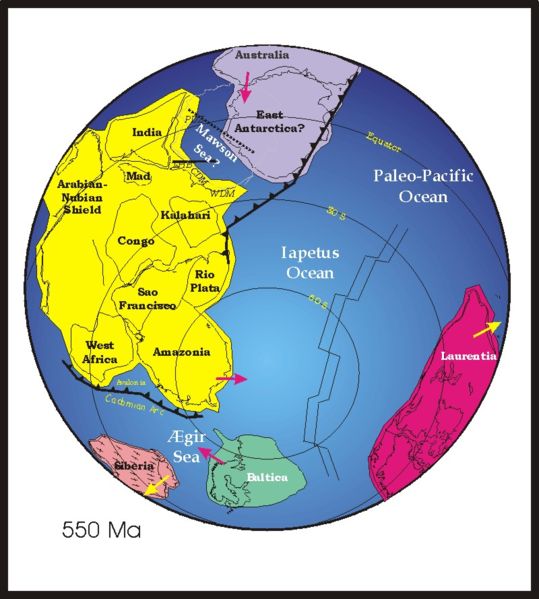
ancient continent of Baltica (green) in relation to other continental land masses, 550 MaThe continent of Baltica (green) existed from the Late Proterozoic to the Early Palaeozoic and included what is now the East European craton of Northwestern Eurasia. Baltica was created as an entity not earlier than 1.8 Ga. Before this time, the three segments/continents that now make up the East European craton were in different places on the globe.

Laurentia is shown in red, Siberia in peach, embryonic Gondwana is yellow, Australia-East Antarctica grey.

The Baltic Shield (Fennoscandian Shield) now forms the continental core of Europe. The shield is composed of the oldest Precambrian crystalline rock in Europe (Archaean and Proterozoic gneisses and greenstone deformed by rounds of ancient tectonic activity.)

The tectonically stable shield region was unaffected by the Caledonian, Hercynian, and Alpine orogenies, though mountains rose at shield margins. The Baltic Shield is exposed in Finland, Sweden, and Norway as a result of scouring by continental ice sheets during the Pleistocene epoch.

[ more on Baltic Shield ]

Labels: , , , , , , , , ,

| 0 Guide-Glossary

craton

cratons are orange areas in image of global geological provinces Cratons, or continental platforms are the ancient, stable geological provinces at the core of continents (orange in image at left). Cratons have peristed for more than 500 million years (some over 2 billion years).

A shield is defined as a craton in which basement rocks have been exposed by erosion at the surface; and such shields typically comprise Precambrian basement rocks.

Cratons characteristically consist of ancient felsic igneous rocks in the crystalline basement at the center of continents, as distinguished from the linear belts of geosynclinal troughs at the margins of continents. Although the oldest rocks and proto-continents date from the Hadean, the earliest large cratonic landmasses formed during the Archean eon when radioactive decay maintained heat flow at three times current levels.

Cratons have a thick continental crust and deep roots that extend into the mantle beneath to depths of 200 km. Cratons sit on anomalously cold mantle that is more than twice the approximately 100 km thickness of mature oceanic or noncratonic continental lithosphere.

Slave Craton

Labels: , , , , , , ,

greenstone belts

greenschist facies - chlorite hand-specimenGreenstone belts are zones named for the green hue imparted by chlorite (left) minerals within the rocks, which are variably metamorphosed (greenschist) mafic to ultramafic volcanic sequences associated with sedimentary rocks. Greenstone belts are found between granite and gneiss bodies in Archaean and Proterozoic cratons.
foliated greenschist
Greenstone belts are interpreted as having formed at ancient oceanic spreading centers and island arc terranes.

greenstone-hosted quartz-carbonate vein depositsGQCV

Shield greenstones are located in:
● Slave craton of Canada (Archaean and Proterozoic)
● Pilbara craton of Australia (Archaean)
● Barberton greenstone belt in Kapvaal craton of southeastern Africa (Archaean)
● western Africa (Archaean and Proterozoic)
● Madagascar (Archaean and Proterozoic)
● Isua greenstone belt of southwestern Greenland (Archaean)
● shield area in Brazil (Archaean)
Baltic craton of Scandinavia and the Kola Peninsula (Archaean and Proterozoic).

[links: images: hand-specimens: greenschists; 3.5 Ga komatiite from Lower Onverwacht Group of Barberton Greenstone Belt; formations: greenschists; Storø shear zone; geological maps: world distribution of world class greenstone-hosted quartz-carbonate vein deposits; Canadian greenstone-hosted quartz-carbonate vein districts; northeast-trending "greenstone" belts of ancient gneiss alternating with belts of metamorphosed volcanic and sedimentary rocks in Minnesota and Canada, Superior Province greenstone belts; x-c, and diagramatic model of northeast-trending belts most likely result from structural deformation of the crust following the formation of the volcanic and sedimentary rocks; diagrams: greenstone belts; model for deposition of volcanic and sedimentary rocks; setting of greenstone -hosted quartz-carbonate vein deposit]

Labels: , , , , , , , , , , , , ,

. . . evolving since 01/07/07