


Baltica
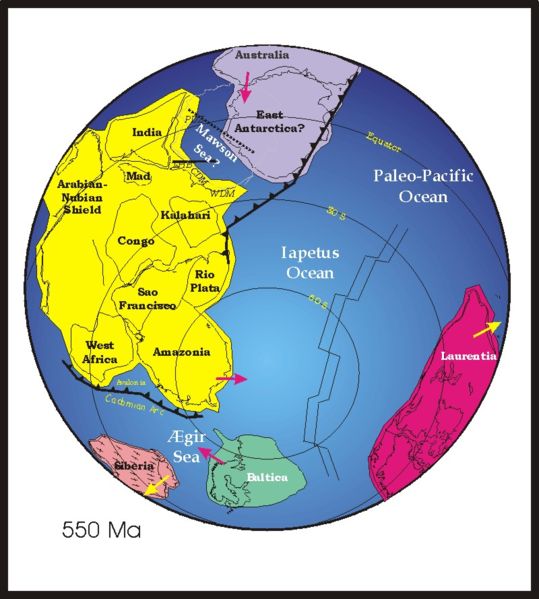 The continent of Baltica (green) existed from the Late Proterozoic to the Early Palaeozoic and included what is now the East European craton of Northwestern Eurasia. Baltica was created as an entity not earlier than 1.8 Ga. Before this time, the three segments/continents that now make up the East European craton were in different places on the globe.
Laurentia is shown in red, Siberia in peach, embryonic Gondwana is yellow, Australia-East Antarctica grey.
The Baltic Shield (Fennoscandian Shield) now forms the continental core of Europe. The shield is composed of the oldest Precambrian crystalline rock in Europe (Archaean and Proterozoic gneisses and greenstone deformed by rounds of ancient tectonic activity.)
The tectonically stable shield region was unaffected by the Caledonian, Hercynian, and Alpine orogenies, though mountains rose at shield margins. The Baltic Shield is exposed in Finland, Sweden, and Norway as a result of scouring by continental ice sheets during the Pleistocene epoch.
[ more on Baltic Shield ]
Labels: Alpine orogenies, Archean, Baltic Shield, Baltica, Caledonian, Hercynian, Laurentia, Paleozoic, Precambrian, Proterozoic
| 0 Guide-Glossary

