Geology

Definitions and images to illustrate geological terms, links to images and website articles

fusibles and refractories

Fusibles are rocks or minerals that melt easily, and are the opposite of melting-resistant refractories.

Sedimentary rocks, which are stable at the Earth's cool surface, tend to be fusible because they consist mostly of stable minerals that have resisted weathering. Crystalline rocks tend to be refractory and to resist melting because they consist mostly of minerals that crystallized out of melts. The most refractory rocks, such as gabbro and peridotite, are stable in the lower crust and the mantle.

Bowen's Reaction Series

Labels: , , , ,

| 0 Guide-Glossary

greenstone belts

greenschist facies - chlorite hand-specimenGreenstone belts are zones named for the green hue imparted by chlorite (left) minerals within the rocks, which are variably metamorphosed (greenschist) mafic to ultramafic volcanic sequences associated with sedimentary rocks. Greenstone belts are found between granite and gneiss bodies in Archaean and Proterozoic cratons.
foliated greenschist
Greenstone belts are interpreted as having formed at ancient oceanic spreading centers and island arc terranes.

greenstone-hosted quartz-carbonate vein depositsGQCV

Shield greenstones are located in:
● Slave craton of Canada (Archaean and Proterozoic)
● Pilbara craton of Australia (Archaean)
● Barberton greenstone belt in Kapvaal craton of southeastern Africa (Archaean)
● western Africa (Archaean and Proterozoic)
● Madagascar (Archaean and Proterozoic)
● Isua greenstone belt of southwestern Greenland (Archaean)
● shield area in Brazil (Archaean)
Baltic craton of Scandinavia and the Kola Peninsula (Archaean and Proterozoic).

[links: images: hand-specimens: greenschists; 3.5 Ga komatiite from Lower Onverwacht Group of Barberton Greenstone Belt; formations: greenschists; Storø shear zone; geological maps: world distribution of world class greenstone-hosted quartz-carbonate vein deposits; Canadian greenstone-hosted quartz-carbonate vein districts; northeast-trending "greenstone" belts of ancient gneiss alternating with belts of metamorphosed volcanic and sedimentary rocks in Minnesota and Canada, Superior Province greenstone belts; x-c, and diagramatic model of northeast-trending belts most likely result from structural deformation of the crust following the formation of the volcanic and sedimentary rocks; diagrams: greenstone belts; model for deposition of volcanic and sedimentary rocks; setting of greenstone -hosted quartz-carbonate vein deposit]

Labels: , , , , , , , , , , , , ,

strata

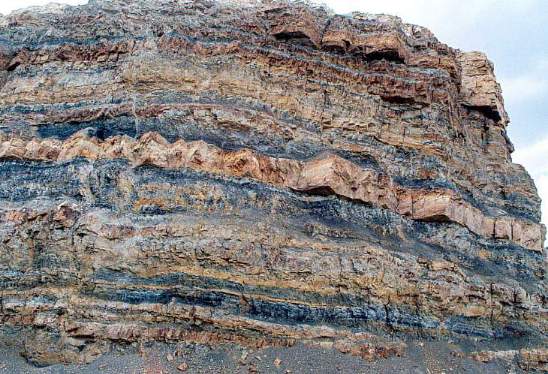
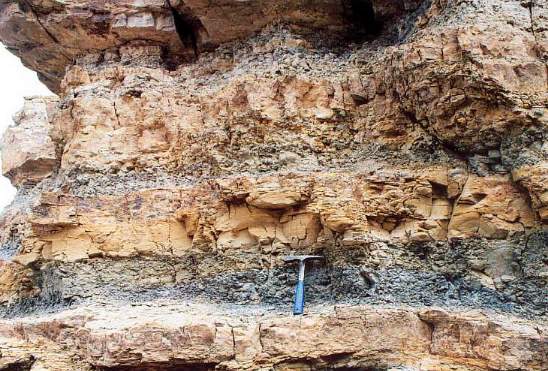
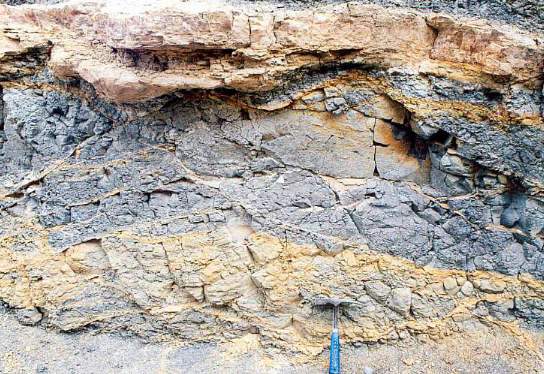
Strata (sing. stratum) are distinctive layers or beds, of sediments or sedimentary rocks deposited consecutively, or with interruption by unconformities, atop other rocks. Each sedimentary stratum has approximately the same composition throughout, reflecting conditions at the time of deposition.

Biostratigraphy is employed to correlate the age of rocks within strata according to their fossil assemblages.

[images : Cerro de Cristo Rey, New Mexico, rock layers in the Anapra formation, 2, 3, close-up of cross-bedding; cross-bedding and flowing water; cross-lamination Pease Bay; cross-bedding Navajo Sandstone; cross-bedding Hawkesbury Sandstone; cross-bedding Kaibab; Scout Lookout; sandstone layering; cross-bedding Glenshaw Formation; slumped and deformed lacustrine sediments of Morale Claim Maar]

For a comprehensive glossary of terminology related to rock strata, see GGIPAC BeddingPattern (pdf) or html version.

Labels: , , , ,

| 0 Guide-Glossary

. . . evolving since 01/07/07