Geology

Definitions and images to illustrate geological terms, links to images and website articles

boudinage

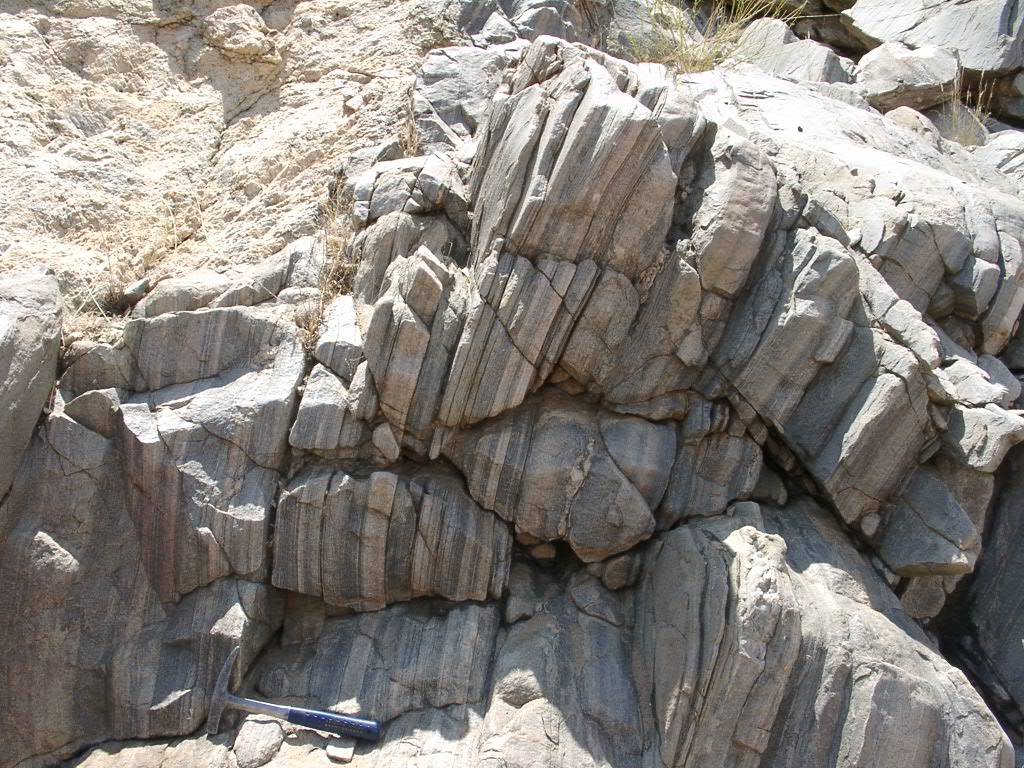
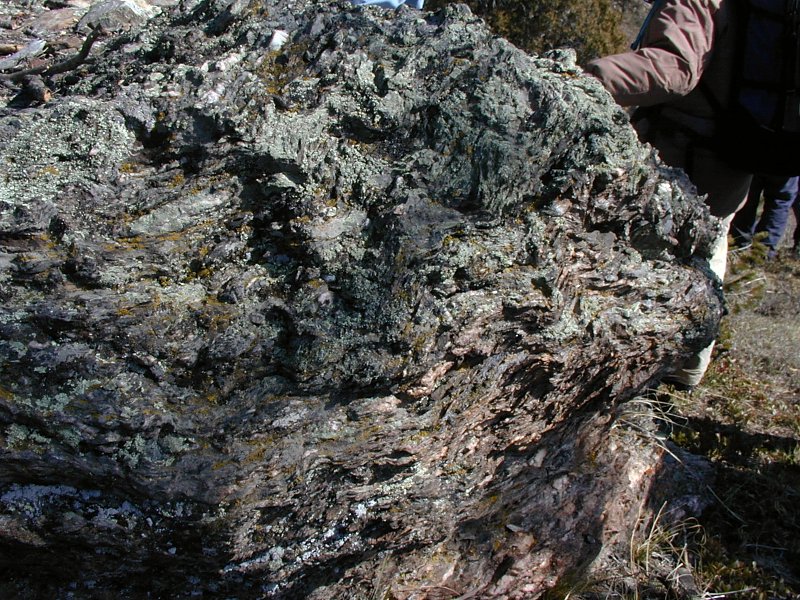
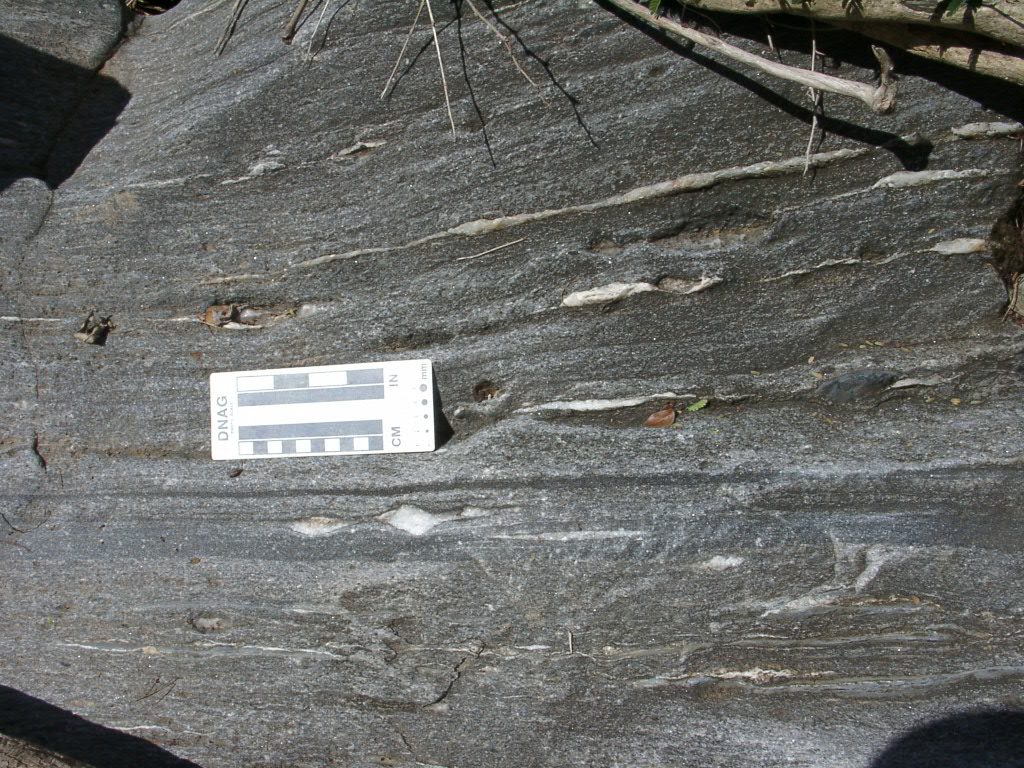
typical example of shear boudinage in deformed jasperoid in sheared basalt, Fortnum Gold Mine, Australia. Courtesy of Roland GotthardBoudinage refers to structures deformed by extension in ductile shear zones. Boudinage structures contain a rigid tabular body that has been stretched and deformed where embedded within more deformable (less competent) rocks.

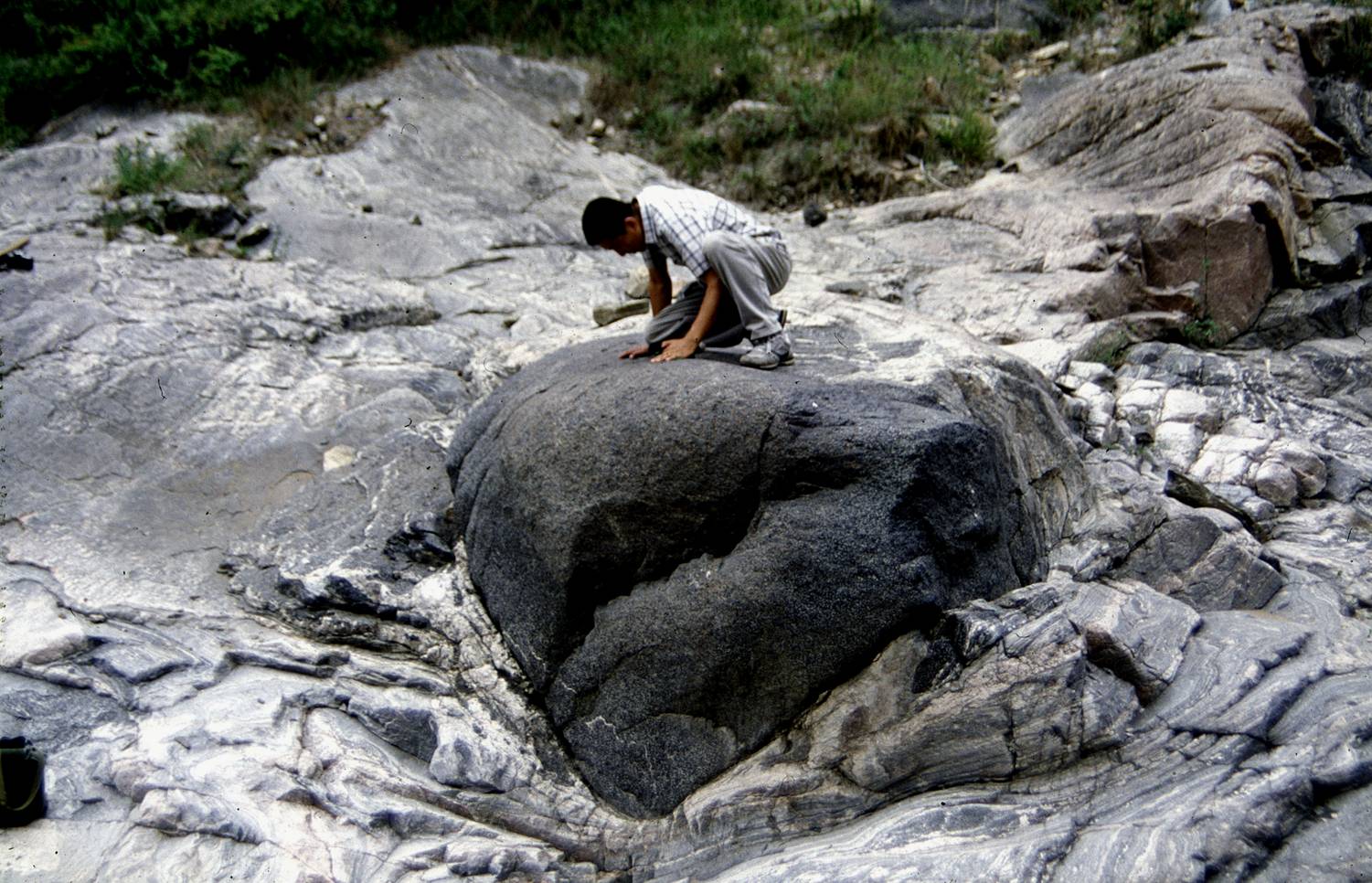
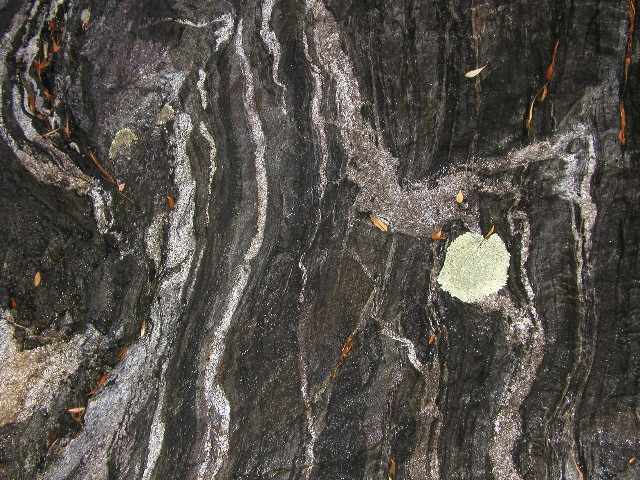
Banded Skagit gneiss with dike of granite orthogneiss; competent banded gneiss is boudinaged by ductile shearCompetent tabular bodies that are susceptible to boudinage include veins and strata such as sandstones. Where conditions favor brittle fracture rather than ductile deformation, imbricate (overlapping) fracturing occurs.


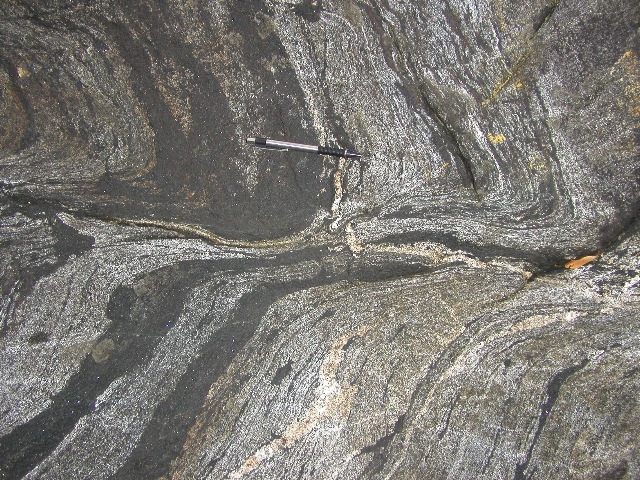
In boudinage, the competent bed break ups into sausage-shaped boudins – forming structures such as ribbon-like boudins or chocolate-tablet boudins (depending upon the axis and isotropy of extension).

boudinaged quartz vein in shear foliation, Starlight Pit, Fortnum Gold Mine, Western Australia. Courtesy of Roland Gotthard.
[links: images: Amphibolite boudins in gneisses; formations: Zoroaster Veining, boudins composed of quartz and plagioclase, boudin of metagabbro (HP mafic granulite) in tonalitic gneiss]

Labels: , , , , , , ,

| 0 Guide-Glossary

deformation

Sediments and rock structures are subject to deformation under the influence of imposed stresses.

Stress is defined as a force applied over an area, F/A.
Stress may be uniform and equal from all directions:
  • ▪ confining pressure of overburden
  • ▪ release from confining pressure due to exposure by erosion (diagenesis and retrograde metamorphism).

    Alternatively, stress may be unequal from different directions (differential):
  • ▪ compression
  • ▪ extension (tensional)
  • ▪ shear stress (applied obliquely)

    Causes of stress include
  • ▪ uniform confining, lithostatic stress due to overburden (burial)
  • ▪ tectonic stress
  • ▪ expansion of water that has frozen in rock cracks or soils (cryoseism)

    When rocks deform in response to imposed stress they exhibit strain, which is the differential change in size, shape, or volume of a material. Materials differ in their responses to stress, depending upon composition, conditions of temperature and confining pressure, and strain rate. However, regardless of intrinsic degrees of brittle or ductile qualities, all strained materials pass through 3 successive stages of deformation: elastic, ductile, and fracture (failure, or brittle deformation). Provided that the strain rate is sufficiently slow to allow minerals to accommodate structurally, minerals can adjust to applied stresses by a variety of mechanisms.

    Forms of deformation include:
    unconsolidated sediments
  • ▪ slumping
  • ▪ folding (fold anatomy)
  • ▪ mass wasting and landslides
  • ▪ faulting (fault attributes)

  • consolidated rock

  • ▪ brittle, ductile, or elastic deformation due to lithostatic or tectonic stresses
  • ▪ --earthquakes
  • ▪ --faulting
  • ▪ --folding
  • ▪ --cataclism, milling, and brecciation
  • ▪ --orogenesis

  • Labels: , , , , , , , , , , , , , ,

    nappes

    Schematic overview of thrust system. A klippe is a solitary outcrop of allochthonous (gray) nappe that is surrounded by autochthonous (brown) material (1). A large, recumbent, overthrust hanging wall block is termed a nappe (2). A window is an erosional hole through a nappe that exposes the underlying autochthonous footwall (3).A nappe is a large, sliver of rock that has been thrusted far from its original position (allochthonous) by thrust faulting during continental plate collisions.

    1. klippe 2. nappe 3. window
    gray = allochthon (thrusted), brown = autochthon (in situ)

    A thrust fault is a special case of low dip-angle fault that formed during regional compressional deformation. The folds associated with nappes are sheared to such an extent that they fold back over on themselves and break apart, producing large-scale recumbent folds of the hanging wall block.

    The underlying autochthonous (original, in-place) rocks are visible in tectonic windows beneath nappes when erosion removes the allochthonous rocks of the nappe. An isolated island of allochthonous nappe rock surrounded by autochthonous rock is termed a klippe.

    Nappes or nappe belts arose during the complex tectonic history of the European Alps. The Austroalpine nappes of the eastern Alps comprise three thrust faulted nappe stacks that lie atop three older Penninic nappes [Subalpine nappes].

    ◙ subduction zone magmas ◙

    [links: images: formations: nappe: folds in the Musconetcong Nappe within the Reading Prong nappe megasystem in Lehigh County; unconformity between coarse basal breccia-conglomerate and the underlying Quarff Nappe metasediments; Morcles nappe; overturned folds in the Liassic limestone and marls of the Helvetic Doldenhorn Nappe, Ferdenrothorn, 3180 m (Loetschental Mountains between the Bernese Oberland and Valais); Flysch turbidite of the Ligurian nappe (constructed of "olistrostromes", undersea landslides), and another overturned turbidite of the Ligurian nappe, siliclastic in the lower (younger) layer, carbonate in the upper (older) layer; the upper part of the Matterhorn is a fragment of Africa, and the lower part is the Jurassic Tethys oceanic crust (Zermatt-Saas ophiolite (lower photo) including pillow lavas and serpentinite bodies (foreground knob on left); klippe: Chief Mountain klippe; Cam Loch klippe; klippe, Salto de gitano; klippe; Carrancas Klippe, Andrelândia Sequence, Minas Gerais; limestone klippe, near Nowy Targ, erosional remnant of a thrust sheet that rests on younger flysch deposits; petrology: eclogites (resulting from prograde metamorphic history of garnet growth during subduction of the oceanic crust) are common in both the Zermatt-Saas complex and older units such as the Sesia nappe (SE) and reflects sections of African continental margin, and HP granitic rocks, including jadeite- and phengite-bearing granites (and relict biotite) in the Sesia nappe; closure of the Donara nappe at the metamorphic core of the Himalaya and Karakoram; Viyazón-Reigada Syncline, Somiedo nappe; maps: 3D topographic/bathymetric render looking down on the Alps from the NW into the Mediterranean Sea and northern Africa (upper). Prior to opening of the Mediterranean, the Apulian plate ("Africa") was thrust onto Europe in the late Mesozoic to early Cenozoic, forming the HP-UHP terranes of the Alps, as well as Greece (upper left) - geological map; geologic map of the Gades Cove geologic window, created as the Great Smoky Thrust Fault was eroded; Map of Cam Loch klippe]

    Labels: , , , , , , ,

    shear zones

    Shear zones involve volumes of rock deformed by shearing stress under brittle-ductile or ductile conditions, typically in subduction zones at depths down to 10-20 km. Shear zones often occur at the edges of tectonic blocks, forming discontinuities that mark distinct terranes. Shear zones can host ore bodies as a result of hydrothermal flow through orogenic belts, are commonly metasomatized, and often display some retrograde metamorphism from a peak metamorphic assemblage.

    Close to the Earth's surface, cool rocks respond to tectonic stresses with fracture and faulting. At greater depths than ductile shear zones, migmatites result from high temperature/high pressure prograde Barrovian regional metamorphism, and at still higher temperatures, rocks melt to form magmas.

    Transpression regimes, such as the Alpine Fault zone of New Zealand, form during oblique collision of tectonic plates and during non-orthogonal subduction. Transpression typically generates oblique-slip thrust faults, strike-slip faults, or transform faults. Microstructural evidence of transpressional regimes include rodding lineations, mylonites, augen-structured gneisses, and mica fish.

    Transtension regimes are oblique tensional environments that result in oblique, normal geologic faults and detachment faults in rift zones. Microstructural evidence of transtension includes rodding or stretching lineations, stretched porphyroblasts, and mylonites.
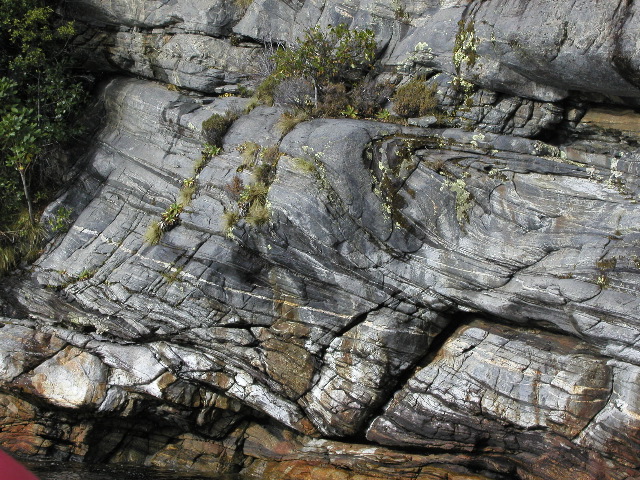
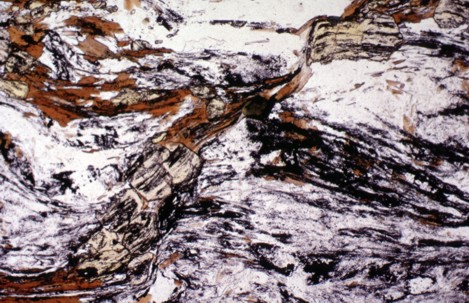
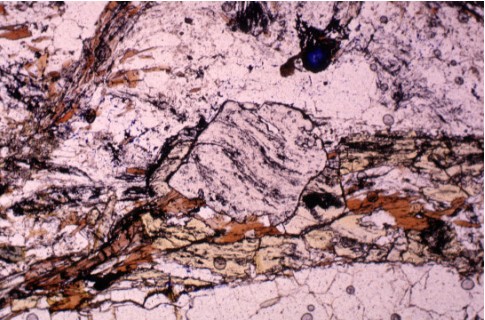
    Shear zones can extend from centimeters to several kilometres in width, and display deformation, folding, and foliations in dynamically altered rocks (breccias, cataclasites, mylonites, S-L-L-S breccia or cataclasite is formed, with the rock milled and broken into a mélange of random fragments.

    Pseudotachylites form at depths from 5-10 km, where confining pressures are focused into discrete fault planes and are sufficient to prevent brecciation and milling. The frictional heating at these depths can melt the rock to form pseudotachylite glass or mylonite, and adjacent to these zones, can result in growth of new mineral assemblages.

    At greater depths, angular breccias transform into ductile shear textures and mylonite zones, as ductile shear zones accommodate compressive stress through dislocation creep within minerals, fracturing of minerals and regrowth of sub-grain boundaries, or by lattice glide along preferred orientation foliation planes in phyllosilicates.

    Within the depth range of 10-20km, ductile deformation conditions prevail and frictional heating is dispersed throughout shear zones, resulting in distributed deformation and a weaker thermal imprint. Here, deformation forms mylonites, with dynamothermal metamorphism observed rarely as the growth of porphyroblasts in mylonite zones.

    ◙ subduction zone magmas ◙

    [links: images: animation: fabric in simple shear; shear zone experiment; formations: mylonitic migmatitic granite-gneiss in shear zone, Epupa Complex, S of Red Drum, NW Namibia; Golden Eagle Shear Zone, Yukon; melt enhanced shear zone, along the base of an intruding batholith; shear zone in the axial zone of the Pyrenees, Parc natural del Cap de Creus, Spain; dike cutting a shear zone, Snake Range, Nevada; sheath fold in boulder, Tarfala Valley, Sweden, and sheath folds, nSweden; fold in high strain zone, NZ; close-ups: ultramylonite core (~1 cm thick) from ductile shear zone of the Diana Syenite of the NW Adirondacks; shear zone related fold in the Kohistan Arc Complex, Northern Pakistan; rock texture in shear zone; rock in ductile shear zone; right-lateral, ductile shear zone; anorthosite in ductile shear zone, Adirondacks; close-up of dextral shear zone; leucosome cuts gneissic layering; 1.7 Ga foliated quartz monzonite of Boulder Creek batholith in Idaho Springs-Ralston shear zone with strong mylonitic (sheared) fabric that parallels the shear zone, 2, 3; 1.7 Ga metapelite (metamorphic marine claystone) that includes large porphyroblasts of pink quartz and andalusite (dull dark gray blocky crystals), and wavy alignment of porphyroblasts in this rock with a mylonitic fabric indicates a complex deformation history; with en echelon antithetic veins in dextral shear zone, Baraboo Quartzite; sigmoidal antithetic fractures in a dextral shear zone, Tiddiline Conglomerate, Bou Azzer inlier, Morocco; mylonitic marble in shear zone, Escambray Massif, Central Cuba; lower greenschist facies shear zone cutting basement schists, assymmetric clast of pegmatite, assymmetric pod of leucogranite in schist, ptygmatic folds of leucogranite in schist, assymmetric pod of schist, Cap De Creus, neSpain; thin-sections: thin section of Lower Ordovician Pinnak Sandstone showing multiple tectonic foliations, the most prominent of which is a crenulation cleavage that overprints an early fine foliation; euhedral staurolite (yellow pleochroic in PPL) overgrows shear zone between large light coloured plagioclase porphyroblasts (graphite inclusions outline shear zone, staurolite crystals postkinematic); garnet with spiral-shaped inclusion trails indicating synkinematic growth, and a dextral sense of shear; diagrams: cataclasite-mylonite in shear zone; block diagram - shear zone host for gold, geometric relationships between structural elements of zone and veins; region within macroscopic shear zone illustrating bimodal porosity distribution within shear zone; model of shear zone]

    Labels: , , , , , , , , , ,

    stress strain shear

    Stress is defined as a force applied over an area, and has the dimensions F/A.

    Shear is a stress that results from the opposition of forces that are not aligned (F/A).

    Strain is defined as deflection divided by the original dimension, and is a measure of deformation, that is, the differential change in size, shape, or volume of a material. Strain is dimensionless.

    The modulus of elasticity is stress divided by strain.

    Lithostatic stress or confining pressure is uniform stress that operates equally in all directions in rocks. Confining pressure is due to the burden of overlying rock, just as seawater exerts equal pressure from all directions at depth.

    Differential or divertorial stress results from compressional or extensional tectonic stresses that are not equal from all directions: tensional stress (stretching), compressional stress (squeezing), or shearing stress (side to side shearing). Compressional stresses act along the direction of maximum principal stress, whereas extensional stresses act along the direction of minimum principal stress.

    For the mutually orthogonal directions along which stress is applied, the
    ▪ maximum principal stress direction is designated σ1 ,
    ▪ minimum principal stress direction is σ3 , and
    ▪ intermediate principal stress direction is designated σ2 .
    ▪ normal stress, directed perpendicular to a given plane is designated, ση
    ▪ shear stress, directed parallel to a given plane is designated, στ
    ▪ vector components of stress can be expressed according to Cartesian coordinate system as 9 components (x,y, z combinations) relative to the 3 mutually perpendicular x-y-z axes

    Materials differ in their responses to stress, depending upon composition, conditions of temperature and confining pressure, and strain rate. However, regardless of intrinsic degrees of brittle or ductile qualities, all strained materials pass through 3 successive stages of deformation: elastic, ductile, and fracture (failure, or brittle deformation). Provided that the strain rate is sufficiently slow to allow minerals to accommodate structurally, minerals can adjust to applied stresses by a variety of mechanisms.

    In elastic deformation, rock changes shape by a very small amount and the deformation is not permanent. Elastic deformation occurs only with small differential stresses, which are less than the rock's yield strength. Rock adjacent to failed rock in earthquakes propagates seismic waves by elastic deformation, then springs back to its original shape in elastic rebound. For this reason, structural damage to rocks and formations provides the only evidence of passage of past seismic waves.

    In ductile deformation, rock deeper than 10-20 km is subjected to enormous lithostatic stress, and the high temperatures of burial render the hot rock softer and more malleable. At these depths, in the lower continental crust and mantle, rock undergoes plastic deformation and flows in response to application of a differential stress that is stronger than its yield strength. Rock undergoes ductile deformation by gradual creep along crystal grain boundaries and planes within crystal lattices. Ductile deformation in generates folding and ductile shear zone features, such the dynamic metamorphic mineralogical and textural changes seen in foliated schistose, banded, lineated, and augen-structured dynamic metamorphic rocks, mylonites, distorted porphyroclasts and mica fish, phyllonites.

    In brittle deformation close to the Earth's surface, where rocks are comparatively cool, rock behaves in a brittle fashion, fracturing in response to differential stress greater than the rock's yield strength. Rock failure and fracture generates faulting, brecciation, pseudotachlites, cataclasis, and slickenside striations. Rock adjacent to the failed rock springs back to its original shape in the elastic rebound that is responsible for earthquakes.

    Labels: , , , , , ,

    . . . evolving since 01/07/07