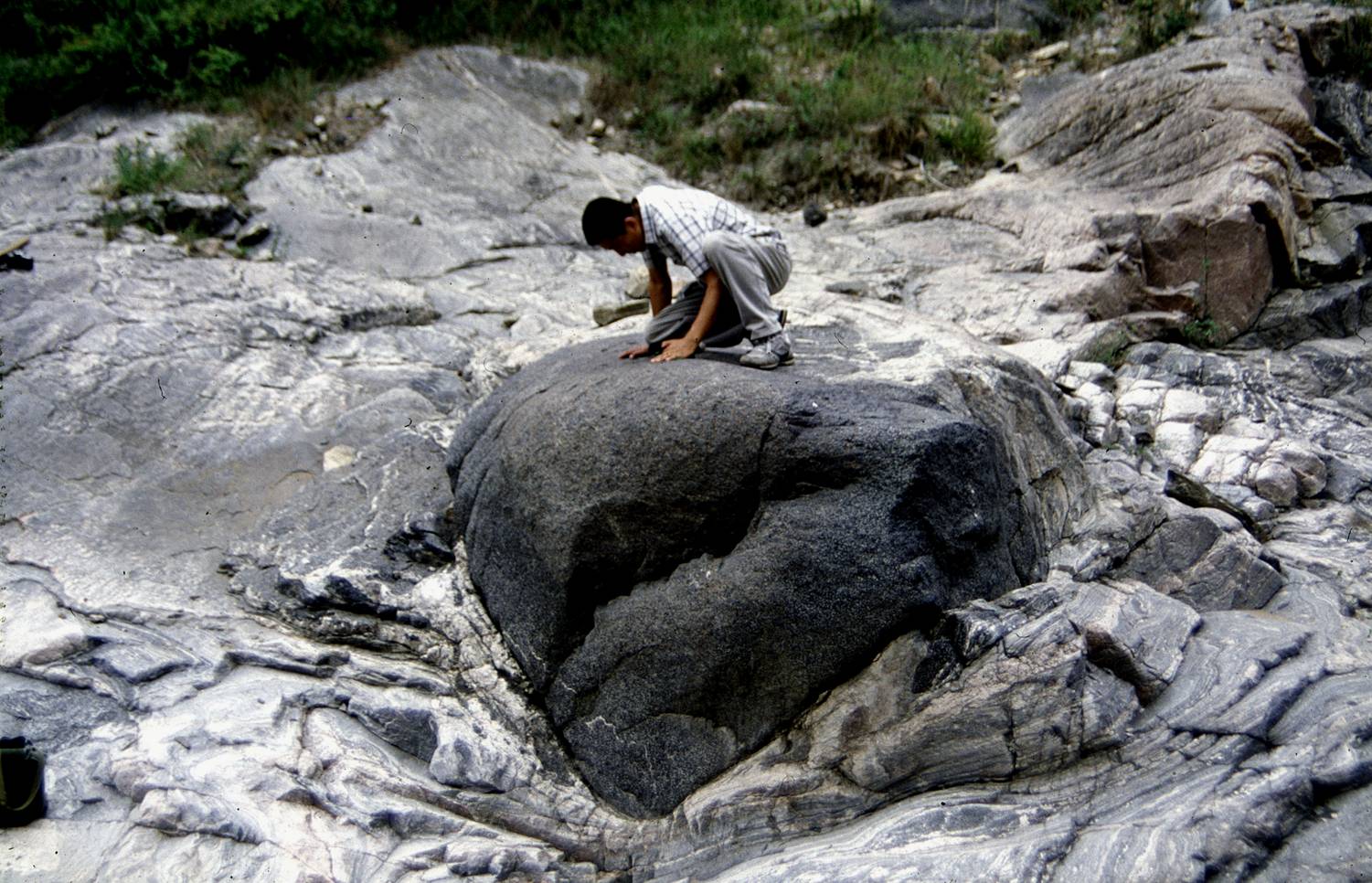
boudinage
 Boudinage refers to structures deformed by extension in ductile shear zones. Boudinage structures contain a rigid tabular body that has been stretched and deformed where embedded within more deformable (less competent) rocks.
 Competent tabular bodies that are susceptible to boudinage include veins and strata such as sandstones. Where conditions favor brittle fracture rather than ductile deformation, imbricate (overlapping) fracturing occurs.
In boudinage, the competent bed break ups into sausage-shaped boudins – forming structures such as ribbon-like boudins or chocolate-tablet boudins (depending upon the axis and isotropy of extension).

[links: images: Amphibolite boudins in gneisses; formations: Zoroaster Veining, boudins composed of quartz and plagioclase, boudin of metagabbro (HP mafic granulite) in tonalitic gneiss]
Labels: boudinage, boudins, deformation, ductile, extension, extension fractures, imbricate, shear zones
| 0 Guide-Glossary