accretionary prism
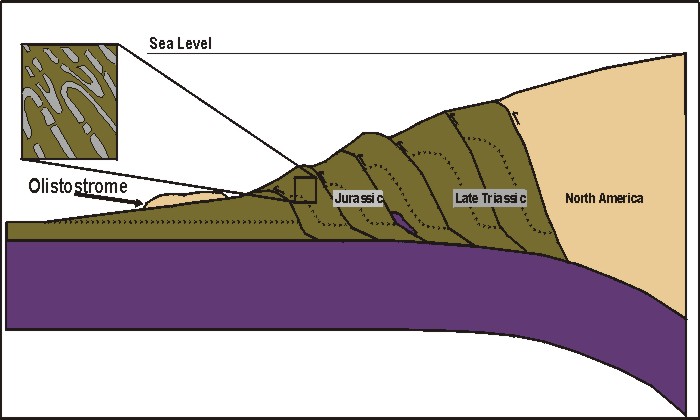
 An accretionary prism, accretionary wedge, or accreted mélange is a wedge-shaped body of faulted and folded material accreted (added) to a continental margin in a subaqueous thrust zone.
A mélange is a body of mappable-sized blocks of different rocks jumbled together with little continuity of contacts. The origins of mélanges are either tectonic, submarine sliding (olistrosomes), or diapirism.
Olistostromes are mélanges formed by accumulation of submarine, gravitational flow as semi-fluid bodies, so are stratigraphic units that lack true bedding, yet are intercalated between normal sedimentary bedding sequences.
Accretionary prisms can arise by:
▪ Having been scraped off subducting oceanic crust and accreted to an island arc or continental margin at a subduction zone.
▪ Accumulation, at greater depth, of a mass of deformed trench sediments and ocean floor sediments on the underside of the tectonic plate that lies above the subducting plate (tectonic underplating). Trenches infilled with thick turbidite sediments typically have listric thrust faults that flatten into a decollement horizon that is often close to the top of the pelagic sediments.
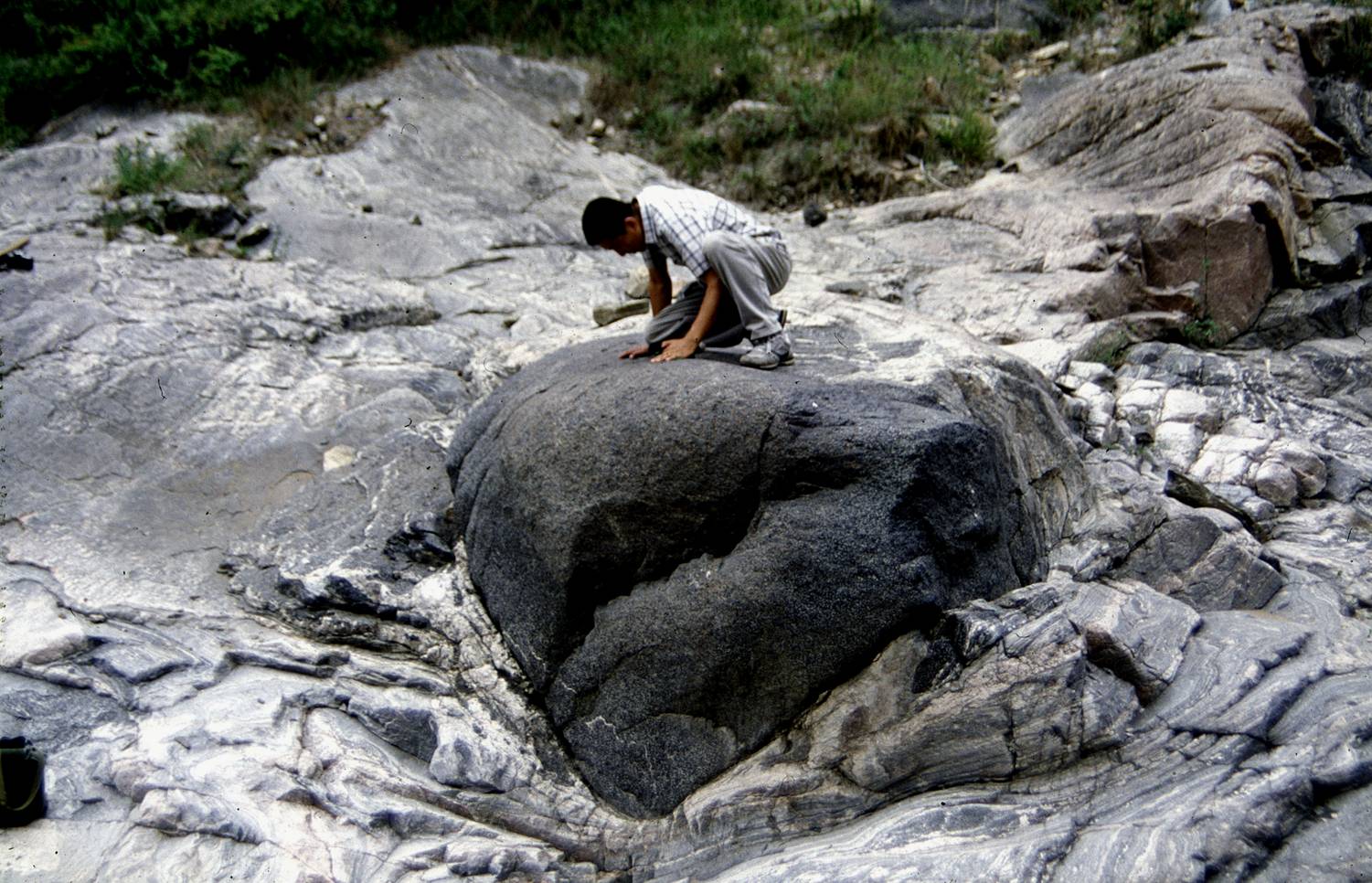
▪ Some accretionary prisms with few reflectors on seismic profiles may contain chaotically deformed sediments (broken formation or mélange) similar to those known from ancient orogens.
Accretionary prisms and accreted terranes are not equivalent to tectonic plates, but rather are associated with tectonic plates and accrete as a result of tectonic collision. Materials incorporated in accretionary prisms include:
▪ Ocean-floor basalts – typically seamounts scraped off the subducting plate
▪ Pelagic sediments – typically immediately overlying oceanic crust of the subducting plate
▪ Trench sediments – typically turbidites that may be derived from:
--- ▪ Oceanic, volcanic island arc
--- ▪ Continental volcanic arc and cordilleran orogen
--- ▪ Adjacent continental masses located along strike (such as Barbados).
--- ▪ Material transported into the trench by gravity sliding and debris flow from the forearc --------ridge (olistostrome)
--- ▪ Piggy-back basins, which are small basins located in surface depression on the accretionary -----prism.
--- ▪ Material exposed in the forearc ridge may include fragments of oceanic crust or high------------pressure metamorphic rocks thrust from deeper in the subduction zone.
◙ subduction zone magmas ◙
[links: images: formations: accretion prisms: Jurassic and Cretaceous Franciscan Formation - an accreted melange or accretionary prism that formed in a trench along a subduction zone; low-grade metamorphosed accretionary complex with greenschist facies metamorphism, shear deformation, crenulation cleavage, kink band, Otaki Group;
diagrams: accretionary prism and olistostrome associated with Santiago Peak Volcanics and associated intrusives; structural zones and lithologic zones and metamorphic zones associated with subduction zones and orogeny; webpages: Geology of the Point Reyes Area, California - accretionary complex of a subduction zone, transform plate boundary, granitic basement of a continental magmatic arc; webpages: trenches and mélanges]
Labels: accretion vein, accretionary prism, continental margin, oceanic crust, subduction, subduction zone, tectonic plate