


enclaves
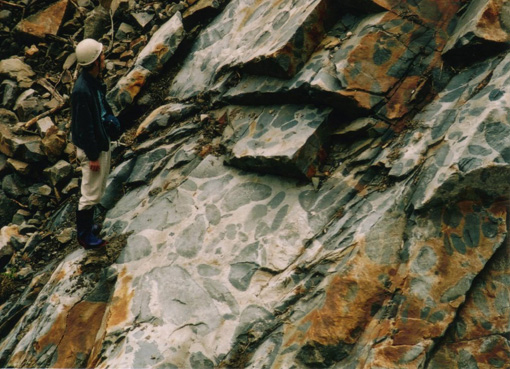
Magmatic enclaves are volumes of rock surrounded by emplaced host rock of related but distinct composition and of separated genesis (incomplete magmatic mixing).
Enclaves are distinguished from xenoliths, which are fragments of metamorphically altered older country rock that fell into magma or lava and became enveloped within igneous rock. Enclaves are also distinguished from schlieren, which are concentrations of mafic material that have crystallized out of a single magma.
Microgranitic (mafic) enclaves are common components of plutonic bodies and may represent the result of mingling of mafic and felsic magmas. These enclaves are often ellipsoidal or elongate in shape.
Studies on mafic enclave-host granite pairs indicate that enclaves and their host granites share compositional characteristics indicating their close relationship, but that the two groups of rocks are not cogenetic. The enclave-host relationship was probably acquired through pervasive mechanical and chemical interaction (especially differential interdiffusion) between two originally independent magmas. Microgranitoid enclaves typically show microstructural
evidence that suggests that prior to incorporation of parent magma globules into the host magma (during magma mingling), the enclaves underwent magma mixing, in a setting where the mafic magma was more abundant than the felsic magma.
The most mafic enclaves are generally the most stable enclaves with respect to disruption by entraining flow, and proto-enclaves with silica contents close to those of the host granite are highly unstable. Enclaves are often interpreted as strain markers. However, most deformation of microgranitic enclaves probably occurs at relatively high temperatures (950 -1050 °C), so the enclaves record magmatic strain of the host over only a limited temperature-time range in the host’s cooling history. Observation of apparent deformation of enclaves in a liquid regime implies that magmatic flow velocities are likely to be below 10 m/yr in enclave-bearing plutonic systems. [r, 2, 3]
[links: images: Mafic microgranular enclave (MME) dense zone in the upper part ofthe Kurobegawa Granitic Pluton, Japan, and mafic microgranular enclaves (MME ) mingled with filsic crystal mush mainly consisting of porphyritic plagioclase and quartz; Rock dragon enclave; magmatic enclave rich in biotite and relatively fine-grained; magmatic enclave at Elephant Rocks; mafic enclave dike; mafic magmatic enclave (Nikia lavas) with quench rims; mafic enclaves in tonalite with leucocratic halos around the mafic enclave, and magmatic fabric in tonalite indicated by prefered orientation of long axis of mafic enclave; diorite enclaves in Ross of Mull Granite show rounded and lobate forms and more angular forms. This varitety suggests that the diorite and granite magmas coexisted as liquids, although it is possible that the granite was partially crystallized when the diorite magma was intruded. Some show complex veining structures, and many have conspicuous K-feldspar megacrysts not present in the main diorite. These textures show that the two magmas have interacted extensively in some cases.; Silvermines Granite at Tiemann Shut-Ins with a variety of enclaves shapes, from rounded / diffuse to sharp / angular; melanocratic enclave in a leucocratic granite; enclave from ERSNA and the ERB, feldspars within this enclave show both rapakivi (left) and anti-rapakivi (right); rock, 2; mafic enclave, Brazil; mafic enclaves in tonalite of Lake Mary, mafic dike in tonalite of Lake Mary containing mafic enclaves similar in composition of that of the mafic dike, 2, mafic dike with dark, chilled margin in tonalite of Lake Mary, concentration of mafic enclaves in tonalite of Lake Mary, mafic enclaves with plagioclase xenocrysts inherited from the tonalite of Lake Mary host, differential weathering of mafic enclaves in tonalite of Lake Mary, aplite dike cutting cluster of rounded mafic enclaves; close-up: spheroidal mafic enclave in granodiorite of Summit Lake; Desolation Valley granodiorite with mafic enclave, surrounding granodiorite has anhedral interstitial K-feldspar and rim myrmekite, but the mafic enclave is not penetrated and replaced by K-feldspar; change in colour related to minute changes in mineralogical composition that may indicate the presence of a magmatic banding; thin-sections: portion of mafic enclave from Desolation Valley granodiorite which contains hornblende (tan), biotite (reddish), albite-twinned and zoned plagioclase (black and white), and quartz (cream); webpages: Igneous Processes in the Moruya Batholith, Igneous and Metamorphic Geology Field Trip.]

Enclaves are distinguished from xenoliths, which are fragments of metamorphically altered older country rock that fell into magma or lava and became enveloped within igneous rock. Enclaves are also distinguished from schlieren, which are concentrations of mafic material that have crystallized out of a single magma.

Microgranitic (mafic) enclaves are common components of plutonic bodies and may represent the result of mingling of mafic and felsic magmas. These enclaves are often ellipsoidal or elongate in shape.
Studies on mafic enclave-host granite pairs indicate that enclaves and their host granites share compositional characteristics indicating their close relationship, but that the two groups of rocks are not cogenetic. The enclave-host relationship was probably acquired through pervasive mechanical and chemical interaction (especially differential interdiffusion) between two originally independent magmas. Microgranitoid enclaves typically show microstructural
evidence that suggests that prior to incorporation of parent magma globules into the host magma (during magma mingling), the enclaves underwent magma mixing, in a setting where the mafic magma was more abundant than the felsic magma.
The most mafic enclaves are generally the most stable enclaves with respect to disruption by entraining flow, and proto-enclaves with silica contents close to those of the host granite are highly unstable. Enclaves are often interpreted as strain markers. However, most deformation of microgranitic enclaves probably occurs at relatively high temperatures (950 -1050 °C), so the enclaves record magmatic strain of the host over only a limited temperature-time range in the host’s cooling history. Observation of apparent deformation of enclaves in a liquid regime implies that magmatic flow velocities are likely to be below 10 m/yr in enclave-bearing plutonic systems. [r, 2, 3]
[links: images: Mafic microgranular enclave (MME) dense zone in the upper part ofthe Kurobegawa Granitic Pluton, Japan, and mafic microgranular enclaves (MME ) mingled with filsic crystal mush mainly consisting of porphyritic plagioclase and quartz; Rock dragon enclave; magmatic enclave rich in biotite and relatively fine-grained; magmatic enclave at Elephant Rocks; mafic enclave dike; mafic magmatic enclave (Nikia lavas) with quench rims; mafic enclaves in tonalite with leucocratic halos around the mafic enclave, and magmatic fabric in tonalite indicated by prefered orientation of long axis of mafic enclave; diorite enclaves in Ross of Mull Granite show rounded and lobate forms and more angular forms. This varitety suggests that the diorite and granite magmas coexisted as liquids, although it is possible that the granite was partially crystallized when the diorite magma was intruded. Some show complex veining structures, and many have conspicuous K-feldspar megacrysts not present in the main diorite. These textures show that the two magmas have interacted extensively in some cases.; Silvermines Granite at Tiemann Shut-Ins with a variety of enclaves shapes, from rounded / diffuse to sharp / angular; melanocratic enclave in a leucocratic granite; enclave from ERSNA and the ERB, feldspars within this enclave show both rapakivi (left) and anti-rapakivi (right); rock, 2; mafic enclave, Brazil; mafic enclaves in tonalite of Lake Mary, mafic dike in tonalite of Lake Mary containing mafic enclaves similar in composition of that of the mafic dike, 2, mafic dike with dark, chilled margin in tonalite of Lake Mary, concentration of mafic enclaves in tonalite of Lake Mary, mafic enclaves with plagioclase xenocrysts inherited from the tonalite of Lake Mary host, differential weathering of mafic enclaves in tonalite of Lake Mary, aplite dike cutting cluster of rounded mafic enclaves; close-up: spheroidal mafic enclave in granodiorite of Summit Lake; Desolation Valley granodiorite with mafic enclave, surrounding granodiorite has anhedral interstitial K-feldspar and rim myrmekite, but the mafic enclave is not penetrated and replaced by K-feldspar; change in colour related to minute changes in mineralogical composition that may indicate the presence of a magmatic banding; thin-sections: portion of mafic enclave from Desolation Valley granodiorite which contains hornblende (tan), biotite (reddish), albite-twinned and zoned plagioclase (black and white), and quartz (cream); webpages: Igneous Processes in the Moruya Batholith, Igneous and Metamorphic Geology Field Trip.]


Labels: deformation, magmatic enclave, magmatic mixing, plutonic, schlieren, xenoliths


